
Airtech Advanced Materials Group partners with CEAD
The partnership enables Airtech Advanced Materials Group to incorporate CEAD Flexbot systems into its advanced manufacturing portfolio.


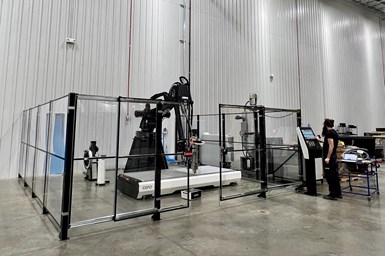
CEAD Flexbot located in Airtech’s facility. Photo Credit: Airtech
Airtech Advanced Materials Group (Huntington Beach, Calif., U.S.) has expanded its additive manufacturing (AM) capabilities through a partnership with CEAD (Delft, Netherlands). The company has integrated CEAD’s Flexbot systems into its advanced manufacturing portfolio, signifying an advancement in its technological capabilties.
CEAD’s Flexbot, a robot-based, large-format 3D printing solution, offers a 3 × 1-meter build volume, CNC milling capabilities and Dynamic Flow Control, making it an all-in-one advanced solution for precision manufacturing. The technology resides in Airtech’s Additive Manufacturing Center of Excellence in Springfield, Tenn., U.S. It plays a critical role in developing resins for 3D printing and exploring applications across diverse market segments.
“CEAD’s fully integrated, robotic printing and milling hybrid solution equips Airtech to support its continued growth in the additive manufacturing [AM] market segment, providing unparalleled support for CEAD and Airtech customers worldwide,” says Gregory Hayes, director of additive manufacturing at Airtech.
Additionally, Airtech’s AM experts are set to deepen their knowledge and expertise through daily utilization and planned developmental activities with the CEAD Flexbot. This will further improve their ability to support global customers using Airtech’s Dahltram resins with CEAD Flexbot and Robot Extruder solutions.
Related Content
-
Composites end markets: New space (2025)
Composite materials — with their unmatched strength-to-weight ratio, durability in extreme environments and design versatility — are at the heart of innovations in satellites, propulsion systems and lunar exploration vehicles, propelling the space economy toward a $1.8 trillion future.
-
Plant tour: Aernnova Composites, Toledo and Illescas, Spain
RTM and ATL/AFP high-rate production sites feature this composites and engineering leader’s continued push for excellence and innovation for future airframes.
-
Bladder-assisted compression molding derivative produces complex, autoclave-quality automotive parts
HP Composites’ AirPower technology enables high-rate CFRP roof production with 50% energy savings for the Maserati MC20.


