
New composite material lowers temp of EV dashboard
Composites may have new function as phase change materials (PCMs) for managing electric vehicle temperature and range.


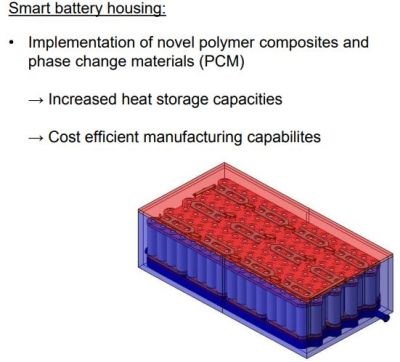
New polymer composites may have multiple functions and end-uses in future EVs.
SOURCE: http://xeric.eu/wp-content/uploads/4_Steiner.pdf
Electromobility is gaining momentum in Germany. As reported by Fraunhofer Institute for Structural Durability and System Reliability (Fraunhofer LBF, Darmstadt, Germany) in July, the number of electric vehicles (EVs) almost doubled in 2017 to 93,000. "To further increase sales of electric vehicles, it is not only necessary to optimize performance, such as range, but also to increase occupant comfort. Among other things, this includes sensible and customer-oriented thermal management in the vehicle interior,” says Paul Becker, who heads the Optimised Energy Management and Use (OPTEMUS) research project at Fraunhofer LBF.
The number of electric vehicles in Germany almost doubled in 2017.
A sub-goal of OPTEMUS was to develop novel materials for the EV dashboard to dissipate the heat caused by solar radiation from the dash surface. Fraunhofer LBF solved this by developing a graphite-filled polyethylene (PE) composite material which is integrated with the EV cooling system. The team has achieved a 46% temperature reduction and reduced the energy needed to operate the air conditioning system, which in turn benefits the vehicle range.
OPTEMUS
An EU-funded project supported by a large team of companies, OPTEMUS aims to overcome one of the biggest barriers for widespread adoption of electric vehicles (EVs): range limitation due to limited storage capacity of electric batteries. Started in June 2015 and wrapping up next February, OPTEMUS intends to develop a number of innovative core technologies and complementary technologies combined with intelligent controls.
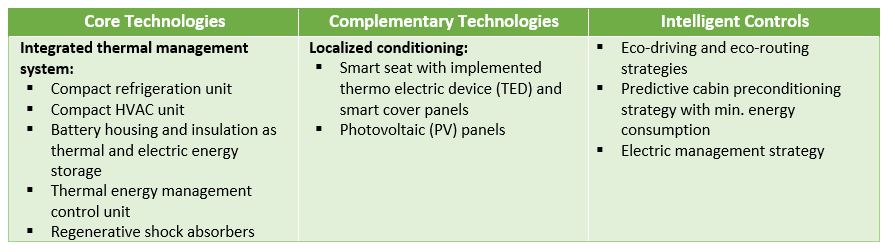
The demonstrator is an A-segment EV (Fiat 500e). This real-life prototype combined with virtual prototyping of the technologies listed below will demonstrate the following objectives:
- Minimum 32% reduction in energy consumption for component cooling and 60% for passenger comfort
- Additional 15% energy reduction available for traction,
- Energy reduction enables an increased driving range in extreme weather conditions > 44 km (38%) in hot ambient and 63 km (70%) in cold ambient conditions.
Composites as Phase Change Materials
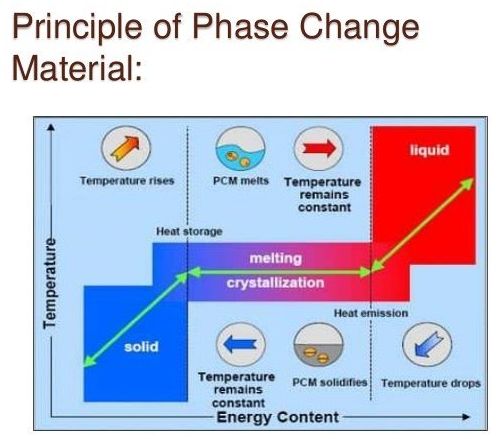
Phase Change Materials (PCMs) have been developed for over a decade for use in buildings, electronics and now cars. PCMs are materials that melt and solidify at certain temperatures with the capability to store or release large amounts of energy during this phase change. Note that solid-gas and liquid-gas PCMs have also been investigated. PCMs may be organic or inorganic compounds, but typically include a conductive filler, which is where graphite comes in. Other PCMs use carbon nanotubes (CNTs).
 |
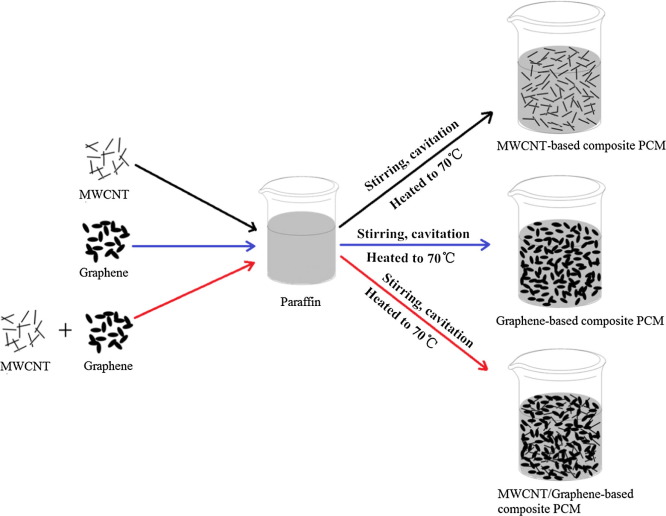 |
omposites are being developed as Phase Change Materials (PCMs) using graphite, graphene and multi-walled carbon nanotubes (MWCNTs).
SOURCE: steemkr.com/science (left) and International Journal of Heat and Mass Transfer, Volume 120, May 2018, Pages 33-41 at ScienceDirect.com (right).
Fraunhofer LBF researchers have experimented with different carrier materials and fillers such as boron nitride and graphite. They ended up with a substrate made of polyethylene, a polymer already commonly used in automotive interiors, and graphite as the filler. The graphite reportedly gives the composite a very good thermal conductivity and rapid heat dissipation as well as excellent energy storage.
The working principles for the graphite/PE composite PCM were completed within the "Smart Cover Panel" par of OPTEMUS. To demonstrate the new material’s benefits, researchers incorporated it into the dashboard of the Fiat 500e prototype and cycled it through heating and cooling phases. Cooling was provided by Peltier elements, which are electrothermal transducers, cooled, in turn, by external fans. Energy for the Peltier elements and EV radiator comes from an additional 12-volt battery powered by photovoltaic cells.
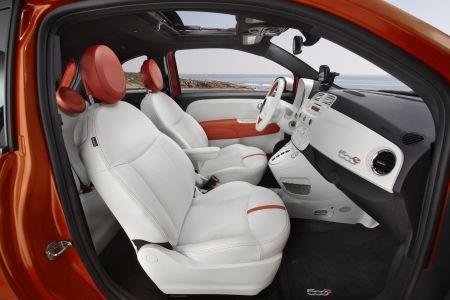
Graphite/polypropylene composite PCM installed in dashboard of Fiat 500e prototype vehicle.
SOURCE: Fraunhofer LBF
LBF researchers used the energy released during the phase transition between heating and cooling to switch on the Peltier elements only for a certain period of time. Thus, the fans do not constantly run at maximum power. The cooling system is coupled to the temperature in the material by appropriate regulation. Fraunhofer believes this will extend the life expectancy of the electronic components. The Smart Cover Panel is actually controlled by the sunlight itself, which means that cooling only starts in hot summer days, while the warmth remains in the dashboard during winter.
Fraunhofer LBF’s new composite PCM was experimentally compared to polypropylene-talcum compound used in conventional dashboards. After 1000 seconds of exposure to 1200 watts/m2 of radiant power, the temperature difference on the surface of the specimens was roughly 41°C, which corresponds to a 46% reduction in temperature.
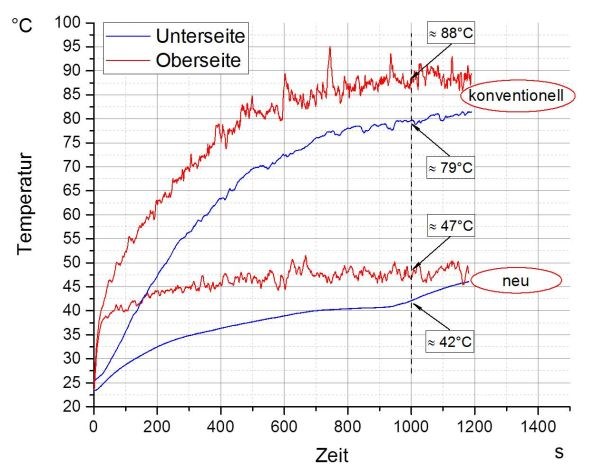
Fraunhofer LBF achieved 46% temperature reduction using the new (“neu”) graphite/PE composite PCM in the dashboard vs. the conventional polypropylene-talcum dashboard compound. SOURCE: Fraunhofer LBF.


Related Content

HydroGraph ramps up efforts to scale pristine graphene offerings
Purchase orders for autocomposite improvement program, patent application filings and additional certifications push the graphene producer on its path forward to commercialization for composites, coatings and lubricants, to name a few.
Read More
Wichita State researchers build composites strength, functionality with helical CNTs
Patent-pending chemically functionalizing helical carbon nanotubes (HCNTs) produce scalable nanocomposites that reduce weak interlaminar bonding, improve bonding, support repair and healing and more.
Read More
Korean researchers develop 3D printed CNT sensors for health monitoring, flexible electronics and smart textiles
CNT-based nanocomposites are optimized specifically for vat photopolymerization-type 3D printing, maintaining high stretchability and electrical conductivity.
Read More
Architected graphene microfillers for lightweighting, reinforcement
CAMX 2025: Dickinson presents its portfolio of “metamaterials,” looking to collaborate with industry partners to demonstrate their scaled-up mechanical capabilities and potential.
Read MoreRead Next

Post Cure: 3D printed plastic, composite mouthstick designs assist limited-mobility users
Three M Tool and Machine has used its in-house additive manufacturing capabilities to rethink medical devices like mouthsticks, which must be stiff, lightweight and comfortable enough for everyday use.
Read More
Report: Composites and Carbon Fiber Use in Hydrogen Storage
A first-of-its-kind technical report that assesses the materials, manufacturing processes, market and energy trends driving use of carbon fiber composites in global hydrogen (H₂) storage applications for fuel cell-powered trucks, buses, trains and passenger vehicles.
Read More
Dialing in composites performance via dynamic digital twins
Sport Dynamics Lab uses Flexdynamics testing, digital models and AI tools to compare designs, materials and systems, enabling optimization with potential for propellers, drones and vibrational structures.
Read More