
No-oven, No-autoclave (NONA)
Room-temperature cure epoxy composites with a 400°F Tg, comparable properties vs. commercial systems without external heat or post-cure, and offering reduced cost and cycle time. Really?


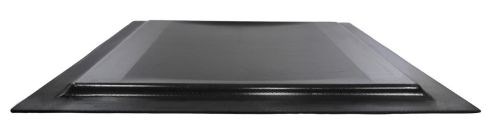
Slightly curved composite tool for Space Launch System (SLS) test panels.
SOURCE: NONA Composites, LLC
No-oven, No-autoclave (NONA) composites technology was developed by Cornerstone Research Group (CRG, Dayton, Ohio) through a 2010 SBIR in conjunction with the National Aeronautics and Space Administration (NASA) Glenn Research Center (Cleveland, Ohio, USA) and is now being commercialized by CRG’s spinoff, NONA Composites LLC (Dayton, Ohio). The original goal was more cost-effective processing of large composite structures and tooling without the large capital expense of autoclaves, ovens or heated tools for cure.
NONA is largely based on what the company terms “commercial off-the-shelf” (COTS) technology. The NONA-001 two-part epoxy resin uses readily available COTS components, combined in its own proprietary formulation. It is processed using conventional resin infusion and low-cost machined foam tooling (i.e., COTS polymeric tooling board). The innovative part is controlling the resin’s exothermic reaction and capturing its heat to achieve full cure and high temperature properties. NONA Composites LLC claim laminates with a glass transition temperature (Tg) of 400°F/204°C achieved via a two-hour cure and six-hour cool-down cycle, enabling service temperatures up to 350°F/177°C.


Recent developments were reviewed in the SAMPE Tech 2013 (Oct 21-24, Wichita, Kan., USA) paper, “No-oven, no-autoclave processing for NASA composite structures”, including construction of a 127cm by 66cm (50-inch by 26-inch) carbon fiber skin/aluminum honeycomb sandwich part and a 117cm by 107cm (46-inch by 42-inch) curved carbon tool as preparation for building a 1:10 scale payload fairing section (including upper barrel and ogive) tool for the NASA Space Launch System (SLS) heavy-lift launch vehicle. The SLS tooling project is now underway and currently scheduled for completion by late Spring 2014. This is one of many out of autoclave (OOA) composite technologies NASA is exploring (see “Tooling up for larger launch vehicles” in September 2013 CT).
NONA composites have also been tested using National Institution for Aviation Research (NIAR, Wichita, Kan.) specifications, in order to provide a comparison with a currently used matrix system — Cycom 5215 OOA epoxy resin from Cytec (Tempe, Ariz., USA), which has an extensive properties listing in the National Center for Advanced Materials Performance (NCAMP) database. The SAMPE paper cited similar performance in seven-day boil, open hole tension (OHT), open hole compression (OHC), and compression after impact (CAI) testing. Compression and tensile properties are still being completed, but the damage tolerance an shear properties have been released (see below). The total number of specimens tested so far is still relatively small, but the initial results look promising. Fiber volumes have ranged from 62 to 67 percent by weight with void content consistently below 1 percent.
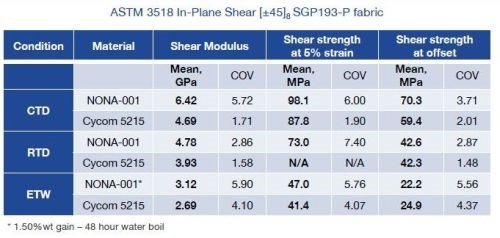
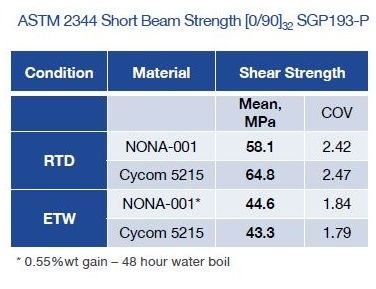
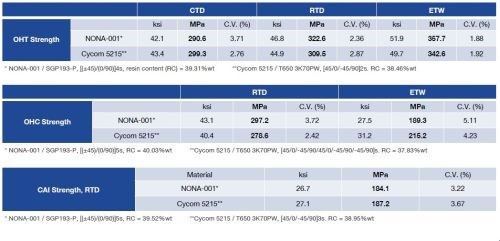

Comparison of NONA process thermal and mechanical performance
to conventional OOA system. SOURCE: NONA Composites, LLC
“We are now working with composite tooling and structures manufacturers,” says Ben Dietsch, NONA Composites LLC chief operating officer, “and have an inventory of resin available to support the increased interest we have received.” He explains companies are seeking reduced cycle time and the ability to make high performance tools from low-cost master models using foam, which machines faster and reduces tooling weight vs. higher density epoxy tooling board. According to Dietsch, though savings are greatest with larger tools, time and cost reductions can be achieved with tools as small as a couple of square feet. “We compare favorably versus LTM tooling prepreg, for example, and we’re also demonstrating advantages beyond tooling, in secondary and tertiary structures.” NONA Composites is also looking forward to primary-type structures, investigating how the NONA resin and curing technology can be combined with toughened prepreg to enable processing benefits for systems already qualified with desired fiber volume and damage tolerance properties.
NONA Composites will exhibit their latest developments at the Wasatch Front Materials Expo (March 5, Salt Lake City, Utah, USA) and CAMX (Oct 13-16, Orlando, Fla., USA).


Related Content

TCR Composites introduces TR1116 snap-cure epoxy prepreg resin system
Designed for press-cure applications, the resin system is highlighted for its snap-cure capability and tailored properties.
Read More
RWC delivers composite frac plugs for downhole environments
Filament-wound fiberglass/epoxy frac plug billets, developed as part of a contract with an oilfield service company, address the very demanding performance needs of oil and gas.
Read More
Electromagnetically transparent GFRP rotor for rare earth magnet-free electric motors
A research consortium within the Baden-Württemberg’s ICM research cluster has created a prototype GFRP wireless power transfer electric motor rotor.
Read More
Plant tour: Airbus, Illescas, Spain
Airbus’ Illescas facility, featuring highly automated composites processes for the A350 lower wing cover and one-piece Section 19 fuselage barrels, works toward production ramp-ups and next-generation aircraft.
Read MoreRead Next

Polestar 5 takes aesthetics and circularity approach to biocomposite seatback design
The 2026 Polestar 5 expands the company’s use of sustainable materials design in the interior, including flax fiber/thermoplastic seatbacks that save 7 kilograms of weight and reduce overall plastics use.
Read More
Bonded fastening meets the digital factory
Automation and XR tools aim to scale adhesive fastening for composites at next-gen aerospace production rates.
Read More
Sentherm conductive polymers match aluminum thermal performance, cut weight
Tailored filler networks, anisotropic material design and manufacturing process control achieve hybrid polymers for EVs, batteries and other automotive-related electronics with 95% of aluminum’s thermal performance and 25-45% reduced component weight.
Read More