
Composite insert as a structural reinforcement for A-pillars
A Porsche structural A-pillar reduces weight and increases strength with a hybrid part combining thermoplastic composites, steel and structural foam.
.jpg;width=70;height=70;mode=crop;format=webp)


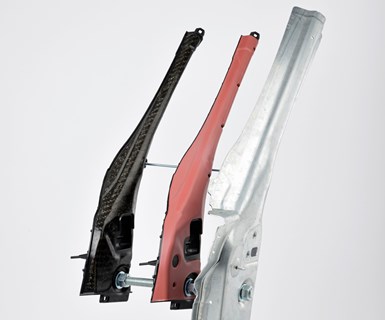
The 3D hybrid A-pillar extends upward from the vehicle rocker panel, accommodates the door hinges and holds the windshield in place at the side. Source | LANXESS AG
The Porsche (Stuttgart, Germany) 911 Cabriolet that rolled out this year is the first vehicle manufactured with a lightweight, hybrid metal-composite A-pillar designed for use in convertibles and roadsters.


The hybrid metal-composite pillar contains an insert made from high-strength steel, supported on the inside by a formed blank of polyamide 6-based LANXESS (Pittsburgh, Pa., U.S.) Tepex dynalite 102-RG600(6)/47% continuous fiber-reinforced thermoplastic composite, and by a ribbed structure made from polyamide 66-based, short glass fiber-filled Durethan AKV30H2.0. This structure is bonded by friction with L-5235 structural foam developed by L&L Products (Romeo, Mich., U.S.). LANXESS says its Tepex line of thermoplastic composite materials is particularly suited for structural components in passenger cars, with their stringent safety requirements.
The strength and rigidity of the hybrid insert ensures that the A-pillar is just as good at withstanding rollovers as previous designs featuring high-strength steel tubes. However, it is 5 kilograms lighter. The weight reduction is achieved in the “greenhouse” area of the vehicle, lowering the car’s center of gravity and thereby improving vehicle dynamics.
“The excellent mechanical performance of the hybrid A-pillar demonstrates that hybrid inserts based on steel sheet, Tepex blanks, polyamide 6 or polyamide 66 variations of Durethan as a back-injection material and on a structural foam such as L-5235 also offer considerable potential for use in structural lightweight vehicle body design. That applies to electric vehicles in particular, as their heavy batteries give them a high impact mass,” explains Henrik Plaggenborg, head of Tepex Automotive at the LANXESS High Performance Materials (HPM) business unit. “The weight reduction also extends the range of the electric vehicles that use this technology.”
Other potential applications for the hybrid composite elements include reinforcing crossmembers and side members, B- and C-pillars, load-bearing battery parts or door components that are critical to safety.
The hybrid composite elements were developed and are manufactured by L&L Products at its site in Strasbourg, France. The first step in the manufacture of the reinforcing elements involves forming and overmolding the Tepex blanks in a single operation using the hybrid molding technology. The resultant composite component is then coated with an epoxy-based foam bonding system that expands in response to heat. The coated part is mounted on the body and goes through the cathodic dip coating (KTL) process with it. The high temperatures of the KTL process cause the structural foam to expand and bond with the high-strength sheet steel, which is also affixed to the A-pillar casing, to produce the reinforcing hybrid insert. This last step takes place in an entirely automated manufacturing process that was developed by Porsche and is subject to ongoing quality control.
The insert and A-pillar development process was supported by LANXESS’ HiAnt customer service operation. “Services included simulating the forming (draping) of the Tepex blanks, simulating filling for back-injection and calculating warpage. We also determined material characteristics to simulate the mechanical behavior of the A-pillar and made these figures available to Porsche,” says Jean-Marie Olivé, expert in application development at HPM.


Related Content

TU Munich develops cuboidal conformable tanks using carbon fiber composites for increased hydrogen storage
Flat tank enabling standard platform for BEV and FCEV uses thermoplastic and thermoset composites, overwrapped skeleton design in pursuit of 25% more H2 storage.
Read More
PEEK vs. PEKK vs. PAEK and continuous compression molding
Suppliers of thermoplastics and carbon fiber chime in regarding PEEK vs. PEKK, and now PAEK, as well as in-situ consolidation — the supply chain for thermoplastic tape composites continues to evolve.
Read More
Materials & Processes: Resin matrices for composites
The matrix binds the fiber reinforcement, gives the composite component its shape and determines its surface quality. A composite matrix may be a polymer, ceramic, metal or carbon. Here’s a guide to selection.
Read More
One-piece, one-shot, 17-meter wing spar for high-rate aircraft manufacture
GKN Aerospace has spent the last five years developing materials strategies and resin transfer molding (RTM) for an aircraft trailing edge wing spar for the Airbus Wing of Tomorrow program.
Read MoreRead Next

From the CW Archives: The tale of the thermoplastic cryotank
In 2006, guest columnist Bob Hartunian related the story of his efforts two decades prior, while at McDonnell Douglas, to develop a thermoplastic composite crytank for hydrogen storage. He learned a lot of lessons.
Read More
CW’s 2024 Top Shops survey offers new approach to benchmarking
Respondents that complete the survey by April 30, 2024, have the chance to be recognized as an honoree.
Read More
Composites end markets: Energy (2024)
Composites are used widely in oil/gas, wind and other renewable energy applications. Despite market challenges, growth potential and innovation for composites continue.
Read More