
Composite deck reduces river ship draft
SAERTEX worked with shipbuilder Neptun Werft to build a composite superstructure to cut weight 45% vs. steel in a river cruiser.


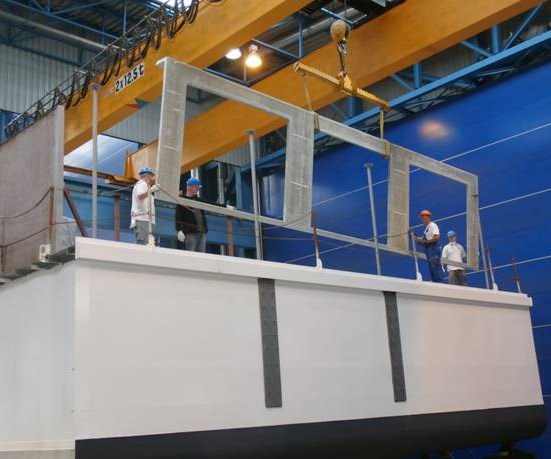
SAERTEX worked with shipbuilder Neptun Werft to build a composite superstructure to cut weight 45% vs. steel in a river cruiser. SOURCE | SAERTEX
This blog is a sidebar to my Dec 2019 feature article, “Removing barriers to lightweighting ships with composites”.
Composite materials supplier SAERTEX (Saerbeck, Germany) began working with Neptun Werft (Rostock, Germany) in 2014, with the goal of cutting weight in a 110-meter long, 11.4-meter wide river cruise ship to extend the vessel’s cruising season. “The river has a low depth in certain months,” explains Jörg Bünker, head of R&D, application service for SAERTEX LEO fire resistant (FR) products. “To reduce vessel draft by 1 centimeter, they must save 11 tons of weight. We worked with them to replace steel with composites in everything above the waterline. Our goal was to cut weight by 45 percent and we achieved this.”


In addition to supplying LEO materials — noncrimp fabric (NCF) reinforcements plus FR foam cores and aluminum trihydroxide-filled or intumescent coatings (see “Withstanding fire without the weight”) — SAERTEX also worked with the shipyard to develop the design and made demonstration parts. “We chose LEO using a glass fiber-reinforced, quasi-isotropic laminate for the faceskins and an FR-modified version of SAERfoam, which has glass fiber composite connections between the faceskins through polyisocyanurate foam core,” says Bünker. “These connections in the SAERfoam enable good structural resistance during the fire and also good residual properties. By using LEO composites, the builder did not have to use additional insulation for temperature and noise as they would with steel. This provides a huge weight saving.”
It took two years to get the design and build approval from the Central Commission for the Navigation of the Rhine (CCNR, Strasbourg, France), which works with inland waterways across Europe. “This long period was partly because the authorities only meet twice per year,” Bünker explains. “After our first proposal, we were directed to collect data and do some fire tests, which we presented at the next meeting. Connections were also an issue. We had to add some fire breaks in the joints between panels and prove fire performance of both composite-composite and composite-steel joints.”
Building the mock-up posed more challenges. “To build in a composites factory is no problem. But to build in the shipyard environment is more difficult. However, this was crucial to convince the authorities. They needed to see it being built and walk on it when it was finished.” He points out that the approval obtained was bespoke, based on the specific design and testing for this vessel. Once approved, the composites were built quickly. The final structure — referred to as a sundeck — used over 1,000 square meters of resin-infused composite panels, joined using tabbing and bonding.
Bünker says the shipyard is now interested in doing more. “They gained a lot of knowledge and it opened their minds as to what is possible.” The two companies have various other projects in progress. SAERTEX is also a supplier for the German national AERONAUT project, which aims to reduce wind resistance/optimize air flow around ship superstructures to reduce fuel consumption and greenhouse gas emissions. “For this, we are working on adding a windscreen/spoiler to the deck house of another inland waterway vessel,” he explains. “The parts are smaller versus the sundeck, but the regulations demand the same work to be done to show equivalency to steel for this new design. This is one of the reasons that we are also supporting the work in FIBRESHIP and RAMSSES, which seek to create a composites-specific and fast track approval process that can be used to obtain a much quicker qualification.”


Related Content

MoistTech Corp. introduces IR3000 moisture sensors
Near infrared (NIR) sensors deliver precision moisture control and reliable moisture analysis for natural fibers, synthetic fibers and blended fabrics.
Read More
Shawmut acquires Fairystone Fabrics
Shawmut Infinite’s purchase of the warp-knitting supplier supports the company’s vision for a fully integrated textile and textile composite supply chain in North America.
Read More
Saertex expands composites reach with NCF facility in China
Saertex Group boosts presence in Asia with Saertex SCF China Ltd. in Pinghu, set to produce advanced carbon fiber textiles for wind, auto and aerospace starting March 2026.
Read More
Braided composites enable low-cost, high-rate fabrication
CAMX 2025: A&P Technology highlights its QISO and slit tape thermoplastic material capabilities through customer examples and industry applications.
Read MoreRead Next

Withstanding fire without the weight
New composites meet stringent fire requirements while lightweighting ships, rail cars and battery boxes for electric cars and planes.
Read More
SAERTEX, Scott Bader to partner on fire protection material system
SAERTEX has announced a strategic partnership with Scott Bader for the production and distribution of the SAERTEX LEO system, fire protection line of materials combining multiaxial noncrimp fabrics and a specifically designed resin system.
Read More
Advancing bonding, coating and sealing to 4.0 systems for composites, metals and more
Brighton Science uses decades of experience, 2-second surface measurements and a framework of data-based specs and KPIs to help manufacturers advance toward reliable, predictable bond quality for faster, high-performance production.
Read More


