
Sigma Engineering adds compression molding simulation to Sigmasoft Virtual Molding
In addition to a reworked user interface, the full process simulation software now includes the ability to view all thermal influences on the component and in the mold.


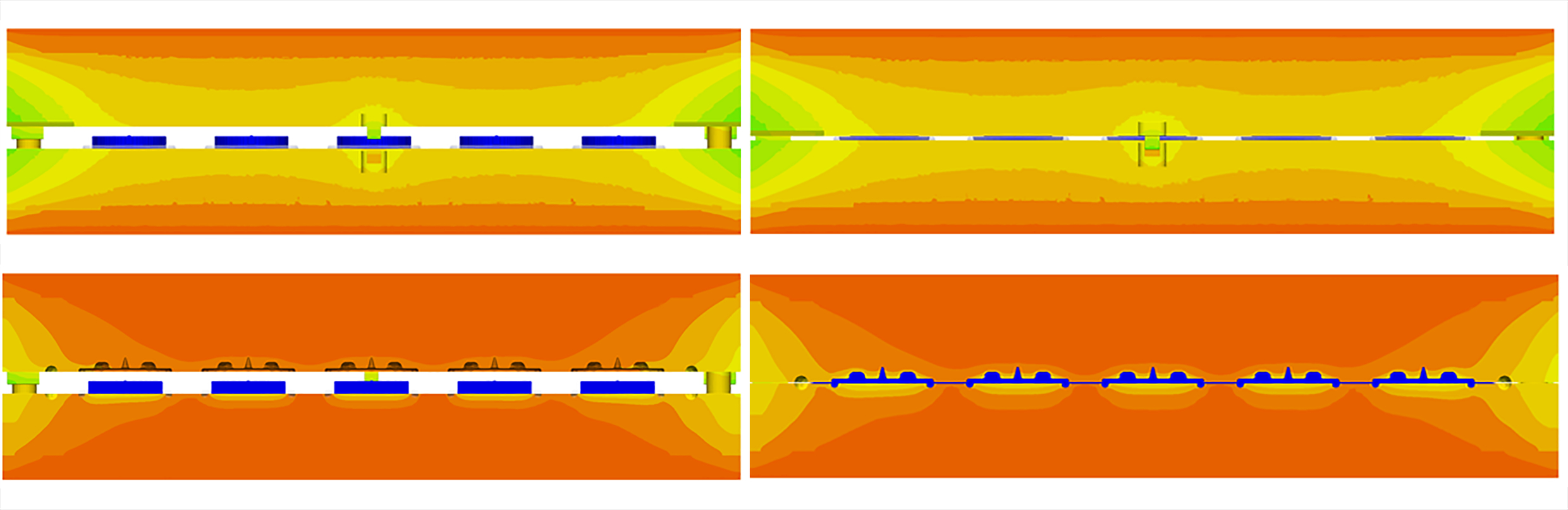
The view of the mold when opening (left) when closing (right). Thermal influences in the mold seen from the outside. Photo Credit: Sigma Engineering GmbH
Sigma Engineering GmbH (Aachen, Germany) presents the evolution of Sigmasoft Virtual Molding, a full process simulation software designed to overcome the challenges associated with development, mold design and production in injection molding. The new version 6.0 is said to have a fresh user interface and, beside other new features, now also contains the possibility to analyze compression molding of elastomers.
Until now, simulative mold and process design were limited mainly to modern injection molding technology, the company says. However, the desire to simulate other processes, such as compression and transfer molding was voiced by several customers, since they are often used to manufacture precision parts.
With the introduction of simulative compression molding, Sigmasoft enables users to zoom into the production process in every location, anytime and in any cycle. Examples include the thermal influence of the open mold, during preparation and while preforms are positioned — or to analyze plastification and curing of the elastomer, or other advanced materials, in detail. The simulation also enables a secure evaluation of curing degree and process-cycle data, according to Sigma Engineering. Issues such as the quantity, shape, weight and position of the preforms can also be optimized easily, ultimately improving the quality of the molded parts while reducing material use.
According to Sigma CTO, Timo Gebauer, the implementation was complex, the challenge primarily stemming from the cavity, which constantly changes during the closing of the mold. At the same time, the inserted preforms are already heating up, and are plasticizing and deforming. Gebauer adds that this development would not have passed the finish line without continuous advice and validation through its customers.
Related Content
-
Plant tour: Aernnova Composites, Toledo and Illescas, Spain
RTM and ATL/AFP high-rate production sites feature this composites and engineering leader’s continued push for excellence and innovation for future airframes.
-
Swiss researchers develop Matrix First concept for 3D printed continuous fiber ceramic structures
SNAPSHOT: Novel manufacturing approach designs internal channels within a 3D printed ceramic architecture for continuous fibers, rethinking how lightweight composite parts can be achieved.
-
Carbon fiber, bionic design achieve peak performance in race-ready production vehicle
Porsche worked with Action Composites to design and manufacture an innovative carbon fiber safety cage option to lightweight one of its series race vehicles, built in a one-shot compression molding process.


