
Toho Tenax hybrid prepreg combines carbon fiber, CNT
New high-tensile, highly shock-resistant prepreg incorporates carbon fiber developed for aerospace applications and specialized carbon nanotubes.

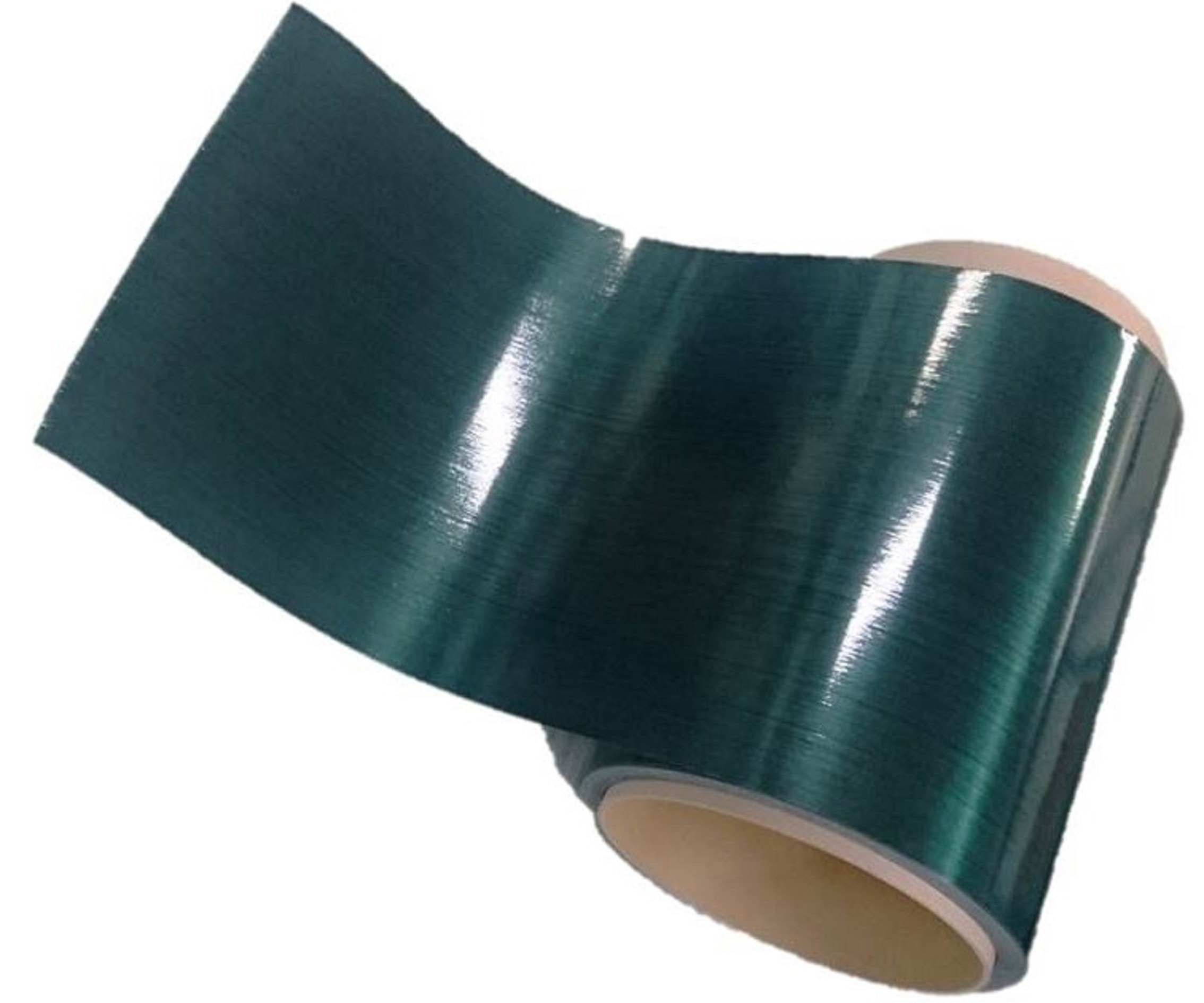


Toho Tenax Co. Ltd., (Tokyo, Japan), the core company of the Teijin Group’s carbon fibers and composites business, announced Feb. 15 that it has developed a new high-tensile, highly shock-resistant prepreg that incorporates carbon fiber developed by Toho Tenax for aerospace applications and specialized carbon nanotubes (CNT). A prepreg is a carbon fiber sheet pre-impregnated with matrix resin and used as an intermediate material for carbon fiber reinforced plastics (CFRP).
The surface of the CNT is specially treated and its structural elements disperse equally when Toho Tenax’s carbon fiber is impregnated with matrix resin containing the CNT. The hybrid combination of carbon fiber and CNT realizes a superior CFRP that offers improved tensile strength and shock resistance. The CFRP also is extra durable because the carbon fiber and matrix resin do not peel away from each other thanks to the CNT’s balanced dispersion.


The Teijin Group is accelerating its development of its new high-tensile, highly shock-resistant prepreg for high-end applications in the sports, leisure and aircraft fields, where weight reduction and high functionality are especially critical.
Since CFRP is used in fields ranging from aircraft and automobiles to infrastructure and leisure, its prescribed properties must differ widely depending on the application. To address these specific demands, Teijin is developing technology for various combinations of carbon fiber and matrix resin and for specific processing needs.
Carbon fiber sheet and matrix resin, however, tend to peel away from each other when molded CFRP products are subjected to strong impact, leading to decreased strength and tension.
Technologies have been pursued to better integrate carbon fiber and CNT, but until now the cohesiveness of CNT elements had prevented them from dispersing equally in the matrix resin, resulting in prepregs of unstable quality.
Related Content
-
Cutting 100 pounds, certification time for the X-59 nose cone
Swift Engineering used HyperX software to remove 100 pounds from 38-foot graphite/epoxy cored nose cone for X-59 supersonic aircraft.
-
Otto Aviation launches Phantom 3500 business jet with all-composite airframe from Leonardo
Promising 60% less fuel burn and 90% less emissions using SAF, the super-laminar flow design with windowless fuselage will be built using RTM in Florida facility with certification slated for 2030.
-
McLaren develops aerospace-inspired ART method for volume composite super car engineering
Automated rapid tape (ART) technique, already deployed at the MCTC and to be used for future McLaren models, is capable of producing lighter, stiffer and stronger carbon fiber structures with less waste.


