
SGL Carbon produces composite leaf springs for Ford Transit
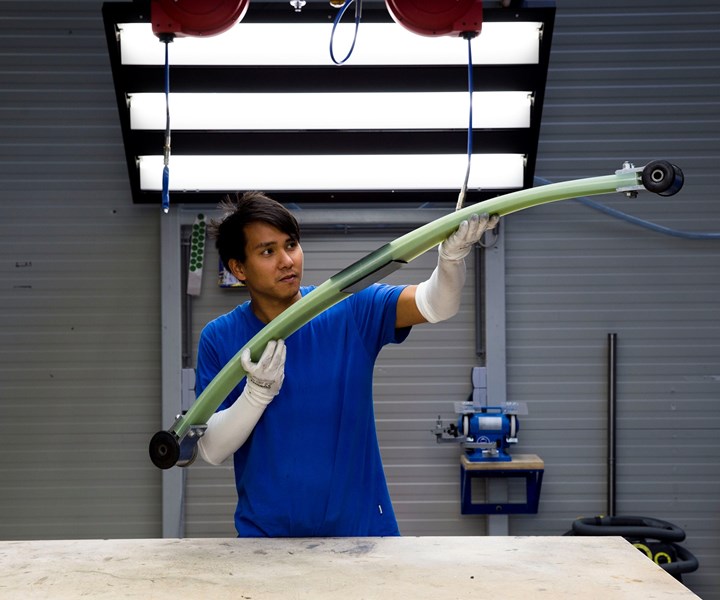
The glass fiber composite, longitudinal leaf springs are said to weigh 50% less than conventional steel springs.
.jpg;width=70;height=70;mode=crop;format=webp)


Source | SGL Carbon


SGL Carbon (Wiesbaden, Germany) announced on Dec. 11 that it is producing glass fiber composite, longitudinal leaf springs for Ford Transit rear axles in series. This is Ford’s first leaf spring project with composites in series worldwide.
The springs, intended for use with the Transit Skeleton chassis, are designed for high payloads and increased security standards, though are said to weigh about 50% less than conventional steel leaf springs. The serial application is supported by a one-to-one compatibility with standard steel springs.
Source | SGL Carbon
According to SGL Carbon, these leaf springs are the first to be manufactured with pre-impregnated glass fiber fabrics, which are produced at the SGL Carbon site in Willich, Germany. The SGL Carbon component plant in Innkreis, Austria, is responsible for the development and serial production of the springs, and the final products are delivered ready to install to the Ford-Otosan assembly plant in Kocaeli, Turkey.
“The design of these composite longitudinal leaf springs for the Ford Transit Skeleton chassis is yet another milestone in the development of production-ready lightweight leaf springs. They are not only characterized by their special material properties and semi-automatic production, but especially by their high compatibility with various customer model variants,” says Sebastian Grasser, head of the Automotive Composites – Fibers & Materials business unit at SGL Carbon.
Related Content
-
McLaren develops aerospace-inspired ART method for volume composite super car engineering
Automated rapid tape (ART) technique, already deployed at the MCTC and to be used for future McLaren models, is capable of producing lighter, stiffer and stronger carbon fiber structures with less waste.
-
Sinonus launches energy-storing carbon fiber
Swedish deep-tech startup Sinonus is launching an energy-storing composite material to produce efficient structural batteries, IoT devices, drones, computers, larger vehicles and airplanes.
-
“Structured air” TPS safeguards composite structures
Powered by an 85% air/15% pure polyimide aerogel, Blueshift’s novel material system protects structures during transient thermal events from -200°C to beyond 2400°C for rockets, battery boxes and more.


