
Montefibre Carbon unveils its first carbon fiber PAN precursor
The company’s 80K carbon fiber precursor for non-aerospace use is expected to be available by mid-2020.
.jpg;width=70;height=70;mode=crop;format=webp)


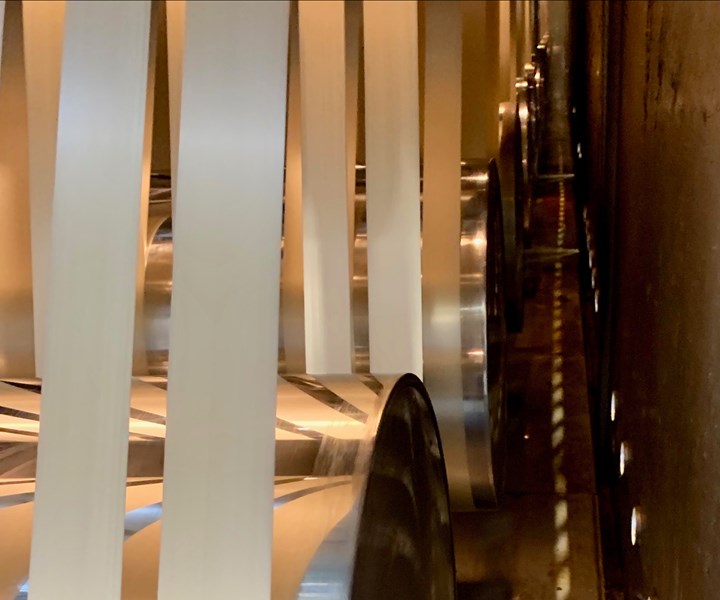
Source | Montefibre Carbon
Montefibre Carbon (Miranda de Ebro, Spain) has announced that it is working on development of an 80K carbon fiber precursor that is expected to be available by mid-2020 and aims to be the new standard for large-tow carbon fiber for industrial purposes. Montefibre's carbon fiber precursor is produced from what the company describes as an exclusive polyacrylonitrile (PAN) formulation that is said to enable a carbon fiber with high elastic modulus and low density, which translates to very rigid and lightweight high-performance composites.


The initial Montefibre 80K product range will consist of PAN under the brand names M500 and M600, both intended for non-aerospace use, with standard modulus (SM). Montefibre says these products are designed to combine affordable pricing and superior fiber quality for large-volume applications.
Montefibre 80-M500-SM has been designed to produce standard industrial quality carbon fiber, type T300, with a tensile strength of 500 ksi (3.5 Gpa) and a modulus of 33 msi (230 Gpa). It is mainly designed for use in sheet molding compound (SMC) for press molding, in pellets for injection molding and milled fiber for 3D printing and construction.
Montefibre 80-M600-SM has been engineered to produce superior quality carbon fiber, with a tensile strength of 600 ksi (4.1 Gpa) and a modulus of 34 msi (235 Gpa), mainly designed for pultrusion, unidirectional (UD) tapes, non-crimp fabric (NCF) prepreg and filament winding.
“The tests we have carried out over the last year have confirmed that the M500 and M600 series have an exceptional thermal profile that allows for high performance and low energy consumption in conventional oxidation and carbonization lines,” says María Simon, Ph.D., research director for Montefibre Carbon.
The first production line of Montefibre 80K fiber is expected to come on line in mid-2020, with an annual capacity of 3,000 metric tonnes of PAN precursor. This first line is expected to produce M500 and M600 precursor, with emphasis on M600. Two other production lines will start operating in 2021, reaching an initial capacity of 11,000 metric tonnes per year, which can be transformed into around 5,000 metric tonnes of carbon fiber. Of these two new lines, the first is expected to produce M600 precursor, and the second M500 precursor.
The Montefibre M500 and M600 series are not subject to export restrictions, the company says, as they are not a precursor of carbon fiber for aerospace or defense use.
“The new M500 and M600 in 80K will make carbon fiber universally accessible to globally expand the substitution of steel, aluminum and glass fiber in many applications outside the aerospace market, such as marine, construction or automotive,” says Alfonso Cirera, president of Montefibre Carbon.
In addition to its own development of 80K, Montefibre Carbon is jointly developing, in collaboration with Oak Ridge National Laboratory (Oak Ridge, Tenn., U.S.), an ultra-wide carbon fiber — 320K and 480K tow — for industrial use. This fiber, which is expected to have properties and applications similar to that derived from the M500 precursor, is scheduled to be launched in 2021 and will be produced at a plant in Knoxville, Tenn.
Montefibre and its production plant in Miranda de Ebro, Spain were acquired in 2015 by the investment group Praedium, owned by Alfonso Cirera Santasusana. The company owns the polyacrylonitrile (PAN) carbon fiber precursor technology developed in the late 1950s by Monsanto in Knoxville, Tenn., U.S. All of this technology is now the exclusive property of Montefibre Carbon, which in the last two years has completed the development of a range of carbon fiber precursor adapted to the needs of the composites industry. Montefibre Carbon says its plan is to become an independent manufacturer of carbon fiber precursor and to reach production of about 33,000 metric tonnes per year by 2025, representing approximately 12% of the estimated 2025 global demand for industrial uses. In the long term, the objective is to reach a capacity of 75,000 metric tonnes of precursor, which the company estimates will be enough material to produce 35,000 metric tonnes of carbon fiber.


Related Content

Co-molding SMC with braided glass fiber demonstrates truck bed potential
Prepreg co-molding compound by IDI Composites International and A&P Technology enables new geometries and levels of strength and resiliency for automotive, mobility.
Read More
Cutting 100 pounds, certification time for the X-59 nose cone
Swift Engineering used HyperX software to remove 100 pounds from 38-foot graphite/epoxy cored nose cone for X-59 supersonic aircraft.
Read More
Plant tour: Airbus, Illescas, Spain
Airbus’ Illescas facility, featuring highly automated composites processes for the A350 lower wing cover and one-piece Section 19 fuselage barrels, works toward production ramp-ups and next-generation aircraft.
Read More
Aviation-specific battery system uses advanced composites to address electric, hybrid flight
BOLDair’s composite enclosure, compression structures and thermal runaway management enables high-performance electric energy storage.
Read MoreRead Next

Sentherm conductive polymers match aluminum thermal performance, cut weight
Tailored filler networks, anisotropic material design and manufacturing process control achieve hybrid polymers for EVs, batteries and other automotive-related electronics with 95% of aluminum’s thermal performance and 25-45% reduced component weight.
Read More
Bonded fastening meets the digital factory
Automation and XR tools aim to scale adhesive fastening for composites at next-gen aerospace production rates.
Read More
Polestar 5 takes aesthetics and circularity approach to biocomposite seatback design
The 2026 Polestar 5 expands the company’s use of sustainable materials design in the interior, including flax fiber/thermoplastic seatbacks that save 7 kilograms of weight and reduce overall plastics use.
Read More