
GE finalizes supply contract for Haliade-X 13 MW variant
The Dogger Bank wind farm will comprise of 190 units of the 13 MW Haliade-X wind turbine, due for completion by 2026.


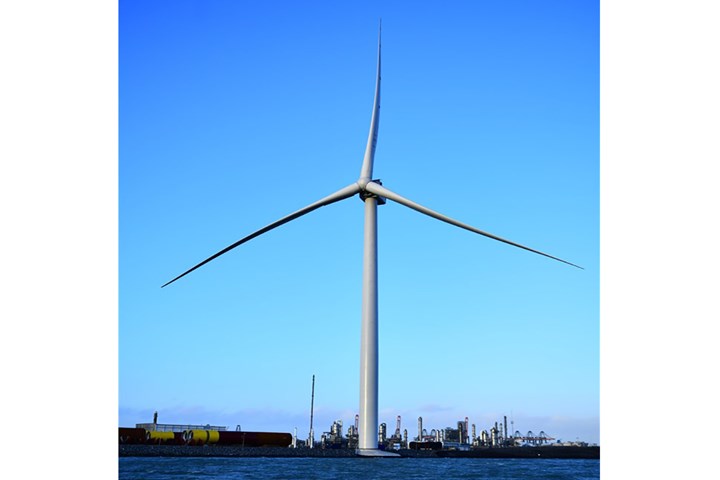
Photo Credit: GE Renewable Energy
GE Renewable Energy (Paris, France) announced on Sept. 22 that it has finalized supply contracts (subject to final notification to proceed) with Dogger Bank Wind Farm off the east coast of Yorkshire, England (a 50:50 joint venture between SSE Renewables and Equinor) for the first two phases of what is said will become the world’s largest offshore wind farm. According to GE, these first two phases (Dogger Bank A and B) will each feature 95 Haliade-X 13-megawatt (MW) wind turbines. GE says this project will be the first to use these 13 MW variant wind turbines.
GE says the agreements will include a total of 190 units of the 13 MW Haliade-X wind turbine, and a five-year service and warranty agreement to provide operational support for the wind turbines. GE’s Service team will be co-located with the Dogger Bank Operational and Maintenance team, based out of the Port of Tyne (located in South Shields, England).


The Haliade-X 13 MW is said to be an enhanced version of the 12 MW unit which has been operating in Rotterdam since November 2019 and which recently secured its provisional type certificate from DNV-GL. The uprated 13 MW Haliade-X will also feature 107-meter long blades and a 220-meter rotor. One spin of the Haliade-X 13 MW is said to generate enough electricity to power a U.K. household for more than two days.
“We are delighted to take the next step in developing the most advanced proven technology in the market,” says John Lavelle, president and CEO, Offshore Wind at GE Renewable Energy. “In signing these agreements with Dogger Bank, our Haliade-X technology will now have an important role to play in the U.K.’s offshore wind ambitions [40 GW by 2030] and greenhouse emission reduction to “net-zero” by 2050.”
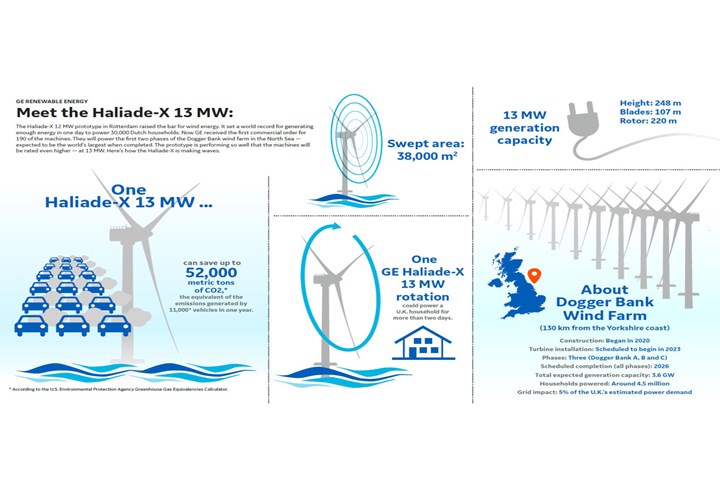
Photo Credit: GE Renewable Energy
It is further confirmed by GE that the project will bring economic benefits to the North East of England. The service and warranty agreements for the first two phases of Dogger Bank Wind Farm will account for around 120 of the operational and maintenance jobs that will be based from the Port of Tyne. In addition, GE Renewable Energy has also confirmed that it will establish its marshaling construction team activities at Able Seaton Port in Hartlepool, which will result in the creation of an additional estimated 120 jobs during the construction period. Recruitment activities are likely to begin early next year.
“I am thrilled to see so many green jobs on the way to the North East of England. Projects like Dogger Bank are absolutely crucial to building back greener from the coronavirus pandemic — creating jobs, growing the economy and tackling climate change. I look forward to watching its progress in the months and years ahead,” comments Energy Minister Kwasi Kwarteng.
The Dogger Bank wind farm is located more than 130 kilometers off the north-east coast of England and will be capable of powering up to 4.5 million homes each year when complete in 2026. Due to its size and scale, the site is being built in three consecutive phases; Dogger Bank A, Dogger Bank B and Dogger Bank C. Each project is expected to generate around six Terrawatt-hours (TWh) of electricity annually.
In the meantime, GE notes that the Haliade-X platform continues to undergo a rigorous series of tests at the U.K.’s Offshore Renewable Energy (ORE) Catapult testing facility in Blyth, at Boston’s Wind Technology Testing Center in the U.S. and at the prototype site in Rotterdam, Netherlands. This prototype unit in the Netherlands, which, according to GE, sets a world record in January 2020 by being the first wind turbine to produce 288 megawatt-hours (MWh) in one day, will start operating at 13 MW in the coming months as part of its ongoing testing and certification process.
Further, GE Renewable Energy will continue its testing and research and development activities on Haliade-X platform in the U.K. by partnering with ORE Catapult and other institutions to develop programs that reduce the time people spend at sea, to increase safety and the use of robotics, digital and remote operations to reduce energy costs.


Related Content

ZEBRA project demonstrates closed-loop wind recycling system
Consortium partners have proven the complete recycling of thermoplastic wind turbines via two manufactured wind blades, featuring reduced operating cost, CO2 emissions.
Read More
Composite bipolar plates provide 81% improvement to hydrogen fuel cell power density
Ultra-thin CFRTP plates developed by Hycco achieve a 7.5 kilowatt/kilogram power density, high durability for fuel cells in long-flight drone and heavy-mobility applications.
Read More
SRI develops scalable, infiltration-free ceramic matrix composites
Work in two DOE projects is demonstrating C/C-SiC produced in 3-5 days with <5% shrinkage, <10% porosity and 50% the cost of conventional C/C and C/C-SiC.
Read More
Composites end markets: Energy (2024)
Composites are used widely in oil/gas, wind and other renewable energy applications. Despite market challenges, growth potential and innovation for composites continue.
Read MoreRead Next

Cutting 100 pounds, certification time for the X-59 nose cone
Swift Engineering used HyperX software to remove 100 pounds from 38-foot graphite/epoxy cored nose cone for X-59 supersonic aircraft.
Read More
Next-gen fan blades: Hybrid twin RTM, printed sensors, laser shock disassembly
MORPHO project demonstrates blade with 20% faster RTM cure cycle, uses AI-based monitoring for improved maintenance/life cycle management and proves laser shock disassembly for recycling.
Read More
Ultrasonic welding for in-space manufacturing of CFRTP
Agile Ultrasonics and NASA trial robotic-compatible carbon fiber-reinforced thermoplastic ultrasonic welding technology for space structures.
Read More