
Plant Tour: Composite Advantage
Composite Advantage supplies engineered fiber reinforced polymer (FRP) products including bridge decks, trail bridges, cantilever sidewalks, rail platforms, as well as waterfront structures such as fender protection systems, pilings and naval ship separators.


An FRP bridge deck at Composite Advantage is being prepared for finishing.
CW photo | Scott Francis


Recently CompositesWorld visited Composite Advantage LLC (Dayton, Ohio, U.S.) for a tour of its facility. The company supplies engineered fiber reinforced polymer (FRP) products including bridge decks, trail bridges, cantilever sidewalks, rail platforms, as well as waterfront structures such as fender protection systems, pilings and naval ship separators.
CW has reported on Composite Advantage’s projects for some time, and was thrilled at the opportunity to check out the facility. At the time of the visit, the company was working on FRP bridge deck panels for a project for the Nevada Department of Transportation’s (NDOT) which will create more than 30 miles of shared-use path along Lake Tahoe. (The project is discussed in detail in a blog post by Composite Advantage.)


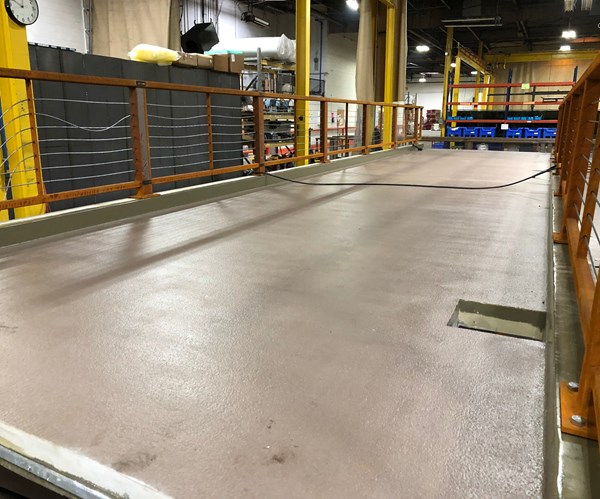
This bridge panel fabricated by Composite Advantage is destined for a shared-use path along Nevada’s State Route 28 along Lake Tahoe.
According to Scott Reeve, president and CEO of Composite Advantage, a solution was needed that could be installed on uneven, rocky terrain. Also, Nevada’s State Route 28 provides the only access to a particular section of the Lake Tahoe coastline, so shutting down the road to pour concrete wasn’t a good option — the right solution would also need to afford quick installation.
“Environmental conditions and traffic concerns dictated a lightweight, prefabricated product,” says Reeve.
Composite Advantage’s FRP bridge deck product was chosen for the job. During the plant tour, CW got a peek at some of the panels in the making.
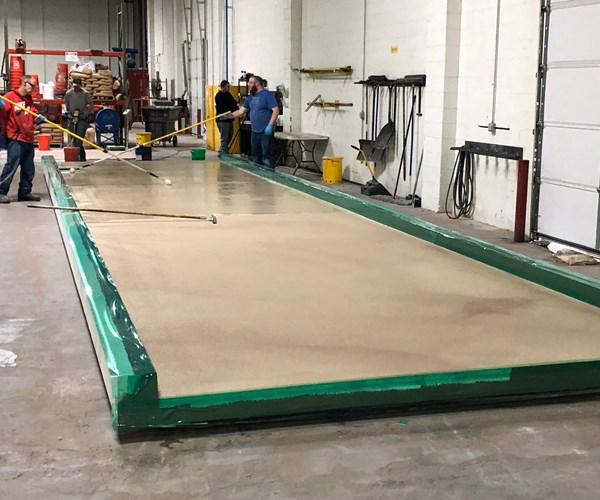
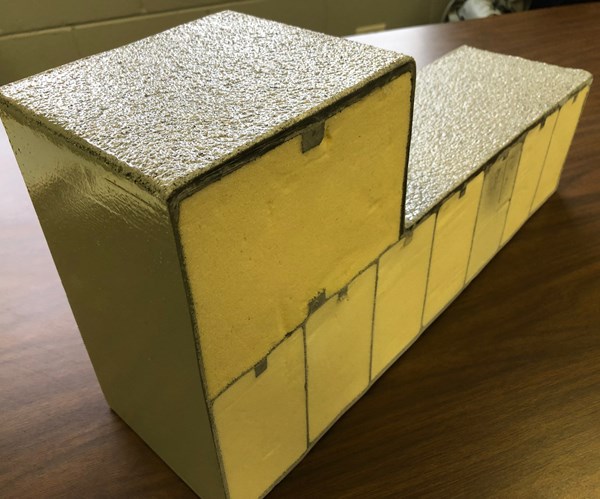
A cross-section of a Composite Advantage bridge deck panel shows the sections of lightweight core material that are encased in glass-fiber fabric and then infused with vinyl ester to create a section of FRP bridge decking.
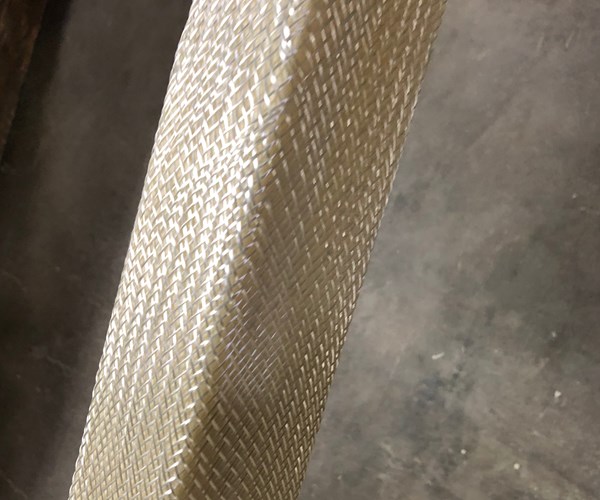
In addition to the bridge decks, Reeve also explained the company’s work with waterfront structures. Composite Advantage’s offerings include composite pilings, fender systems and camels (which are bumpers that protect naval vessels).

“Our pilings are the ‘fence posts’ that support wales or guard rails in a fender system,” explains Reeve.
He indicated that piling systems are an area where FRP can make a huge difference, not just in terms of weight savings and corrosion resistance, but in terms of cost.

“We’re able to fabricate our pilings with a high strength-to-weight ratio which means we can make a very structurally efficient pile,” says Reeve. In a recent project in New Jersey’s Cape May Peninsula, the company’s FiberPILE FRP system was able to cut the number of piles needed for the structure in half, thereby offering cost savings. Composite Advantage met the necessary 250 kip-foot energy absorption impact load using 53 composite piles, ultimately replacing 141 original wooden piles.
The role of composites in infrastructure is at an interesting point. In August of 2018, bipartisan legislation was introduced in the U.S. aimed at encouraging research and use of innovative materials for infrastructure projects. Known as the Innovative Materials for America’s Growth and Infrastructure Newly Expanded (IMAGINE) Act, the bill seeks to lead decision makers involved in construction and infrastructure projects to consider innovative materials as an option. By educating about the benefits and properties the materials offer, infrastructure projects might be envisioned with the right material for the job.
With its experience working to offer solutions like FRP bridges and waterfront structures that offer high strength, corrosion resistance and improved material lifetime, Reeve says Composite Advantage is involved in those discussions in Washington D.C. and efforts to educate decision makers about the benefits of composites. And in the meantime, they’re creating and rehabilitating structures that stand the test of time. One might say Composite Advantage is a company working to build bridges in more ways than one.
Check out Composite Advantage’s blog post about the visit for more insights.


Related Content

Composite resins price change report
CW’s running summary of resin price change announcements from major material suppliers that serve the composites manufacturing industry.
Read More
Induction heating system enables OOA composites processing
JEC World 2025: Roctool focuses attendees’ attention on the light induction tooling (LIT) system targeting efficiency, sustainability and performance.
Read More
Bladder-assisted compression molding derivative produces complex, autoclave-quality automotive parts
HP Composites’ AirPower technology enables high-rate CFRP roof production with 50% energy savings for the Maserati MC20.
Read More
Using pi joints to expand a composite wing’s flight envelope
DarkAero replaced butt joints in the center wing box assembly to increase the flight test envelope in high-speed gust load conditions for its DarkAero 1 prototype composite aircraft.
Read MoreRead Next

Dialing in composites performance via dynamic digital twins
Sport Dynamics Lab uses Flexdynamics testing, digital models and AI tools to compare designs, materials and systems, enabling optimization with potential for propellers, drones and vibrational structures.
Read More
Advancing bonding, coating and sealing to 4.0 systems for composites, metals and more
Brighton Science uses decades of experience, 2-second surface measurements and a framework of data-based specs and KPIs to help manufacturers advance toward reliable, predictable bond quality for faster, high-performance production.
Read More
Report: Composites and Carbon Fiber Use in Hydrogen Storage
A first-of-its-kind technical report that assesses the materials, manufacturing processes, market and energy trends driving use of carbon fiber composites in global hydrogen (H₂) storage applications for fuel cell-powered trucks, buses, trains and passenger vehicles.
Read More


