
Molding in fasteners to CFRP parts
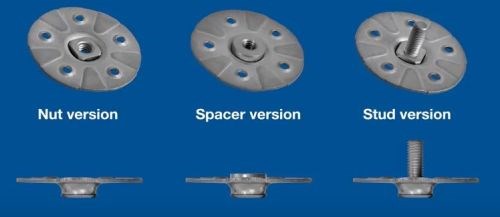
Placed into the mold prior to RTM, compression or injection molding/overmolding, this specially-shaped fastener enables composites to be fastened with standard methods used for metal parts.


The goal was a fastener strong enough to fasten a composite part, but also be cost-competitive and amenable to high-volume production. “Attachment to metal floors can be easily industrialized using fully robotic processes,” says Bernard. “So the idea for IMTEC HR was an industrialized solution for composites with no manual operations.” IMTEC HR fasteners can be placed into the mold for a composite floor structure and integrated during the molding process. Bernard cites IMTEC HR as compatible with thermoset and thermoplastic molding processes, including resin transfer molding (RTM), compression molding and injection molding/overmolding.
For injection molding, the fastener is robotically placed first onto a pin fixed on the mold. The pin locates the fastener and protects the threads inside of it from being coated with resin. Next, the composite material is robotically placed into the mold. The mold is closed, the plastic injected and the part demolded with fastener integrated.
For compression molding, the process is essentially the same except the pin is a plastic screw-off “cap” and also serves to push the material aside for inserting the fastener into the composite, thereby eliminating the need for hole drilling. This not only saves time, it avoids cutting the fibers. The pin cap again protects interior threads during molding and is removed after the part is demolded.
“There are no extra operations once the floor is produced,” notes Bernard. “We believe this technology helps to make composite floors or any other structural parts with an affordable production cost. It replicates the used of blind rivets with metal floors because the fastener is already there in the molded composite part. You now attach the seat with standard methods. This equals the playing field because parts can be attached to a composite floor the same as to a metal floor.”
SOURCE: Böllhoff
To resist galvanic corrosion, IMTEC HR is available in zinc-plated steel and in stainless steel, the latter used mainly for carbon fiber reinforced plastic (CFRP). Different fastener versions are also available, including bolts (studs), nuts and spacers. “We can also change the size of the holes and dimensions of the fastener to meet specific requirements,” says Bernard.
Special shape for energy absorption
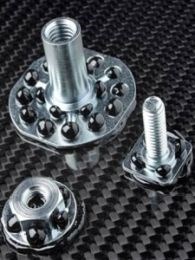
I asked Bernard about the shape of these fasteners, explaining they looked similar to others I had seen, including Big Head and Spida Fixings. He said the shape is reminiscent but different, developed to allow the gradual release of energy during crash conditions. “It is strong enough to provide a high mechanical performance but can absorb energy in crash test conditions to avoid catastrophic brittle failure,” he explains. “It enables elastic then plastic deformation without breaking. Without this behavior, the composite floor at the attachment would deform and break or the metallic fastener would break. This was one issue with adapting fasteners for composite structures.”
 |
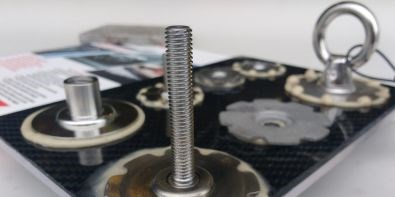 |
Big Head (left) and Spida Fixings (right) fasteners for composites.
SOURCE: Big Head and Spida Fixings.
Another aspect of the shape is the petals. “These are designed to embed in the composite material during molding,” says Bernard. “You must design this fastener to embed in the part and not be left in the mold.” He also notes that the fastener flange is behind the composite part and does not reduce the part section thickness. “This is important to achieve an embedded fastener while maintaining the part section, which gives structural properties.”

Böllhoff’s IMTEC HR fastener developed for molding process embeds into the composite part without reducing section thickness. SOURCE: Böllhoff.
A special version of IMTEC® HR has been developed with Cetim which is compatible with the QSP production line. Cetim is the French research organization that has developed the Quilted Stratum Process (QSP) for highly automated production of composite parts.
According to an article published by Cetim, the patent pending IMTEC HR fastener developed for QSP shows a 30-75% increase in pull-through performance and 60-75% improvement in lap-shear performance compared to conventional fasteners.


Related Content

Syensqo, Teijin Carbon achieve aerospace qualification for composite resin
Resin infusion system Prism EP2400 achieves NCAMP qualification with Teijin Carbon’s advanced NCF and UD reinforcements.
Read More
Clean Aviation's regional aircraft technology testbed #2 demonstrates advances with composites
European project advances OOA outer wing box using resin infusion and thermoplastic composite technologies.
Read More
Composite Integration presents webinar on liquid resin infusion
On July 30, 2025, company experts will discuss the role of LRI in delivering scalable, OOA composite production for the aerospace sector.
Read More
Bladder-assisted compression molding derivative produces complex, autoclave-quality automotive parts
HP Composites’ AirPower technology enables high-rate CFRP roof production with 50% energy savings for the Maserati MC20.
Read MoreRead Next

Automated Preforming, Part 3: Quilted Stratum Process
CW’s tour of Cetim and the QSP line which preforms multi-thickness thermoplastic materials in 40-90 seconds for composite parts with cycle times of 1-2 minutes.
Read More
Advancing bonding, coating and sealing to 4.0 systems for composites, metals and more
Brighton Science uses decades of experience, 2-second surface measurements and a framework of data-based specs and KPIs to help manufacturers advance toward reliable, predictable bond quality for faster, high-performance production.
Read More
Dialing in composites performance via dynamic digital twins
Sport Dynamics Lab uses Flexdynamics testing, digital models and AI tools to compare designs, materials and systems, enabling optimization with potential for propellers, drones and vibrational structures.
Read More


