
Researchers introduce capillary-driven method for continuous fiber 3D printing
The LITA 3D printing system from the University of Delaware shows potential for in situ cure for high-performance carbon fiber composite parts.
.jpg;width=70;height=70;mode=crop;format=webp)


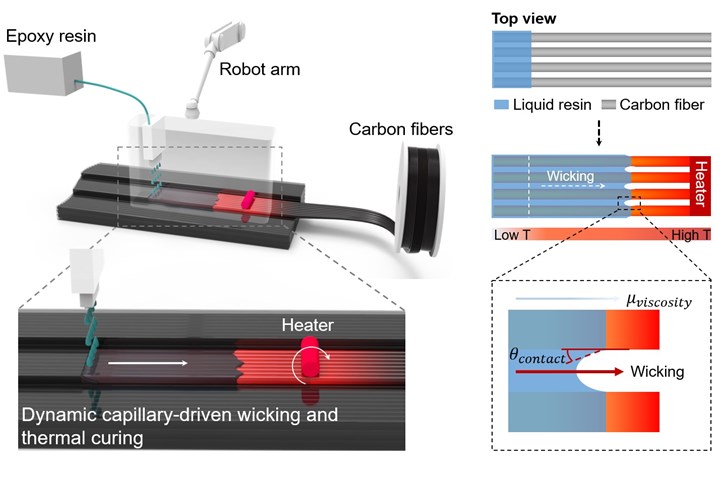
Source | University of Delaware
New research in continuous-fiber 3D printing shows potential for additively manufactured composite parts for a range of industries — including space. Published in the academic journal Matter, researchers from the University of Delaware’s (Newark, Del., U.S.) Center for Composite Materials (CCM) recently introduced a lab-scale method for continuous-fiber 3D printing that incorporates robotics and a capillary-based, in situ heat cure system for fast, additively manufactured carbon fiber composite parts using high-temperature thermoset resins.
“We call it one-step 3D printing,” says Dr. Kun Fu, assistant professor at the University of Delaware and an author on the study. Called the localized in-plane thermal assisted (LITA) 3D printing method, the system comprises an all-in-one printhead mounted on a robotic arm that includes carbon fiber dispensed from a spool, a guiding bar, a liquid resin nozzle and an electric heater. As the fiber is placed onto the part surface, liquid resin is sprayed onto the fibers and is immediately followed by the heater, which, Fu explains, both aids in infusion and in curing of the part. Fu adds that the heating process reduces the viscosity of the room-temperature resin, helping it to infuse into the fibers without need of a vacuum along capillaries, or tube-shaped gaps, between the fibers. Depending on the needs and size of the part being manufactured, Fu says, the temperature of the heater can be increased or reduced to control the viscosity of the resin.


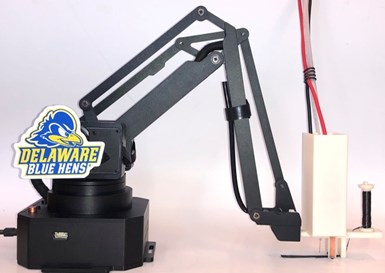
The current, lab-scale LITA 3D printing system. Source | University of Delaware
This method reportedly enables nearly simultaneous wetting and curing of continuous fibers with thermoset resins, with potential to quickly producing 3D composite components with complex geometries and the high mechanical properties that come from continuous fibers and high-temperature thermosets. The researchers have also demonstrated the system can be used for horizontal and vertical printing, Fu says, and on planar or curved surfaces, adding to the system’s flexibility.
“The technique has been very promising so far,” Fu says, “and as far as we know, we’re the first to publish a technique like this.” According to Fu, the researchers are in the process of obtaining a patent for the technology.
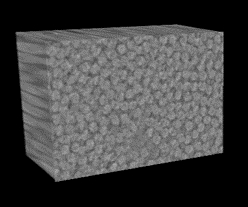
3D CT image of a composite produced with LITA 3D technology. Source | University of Delaware
In addition, the University of Delaware and partner KAI (Dallas, Texas, U.S.) recently received a NASA grant to use the LITA 3D printing method for manufacture of continuous carbon fiber-reinforced composite components for thermal protection systems on NASA spacecraft and lander systems. Fu says that the LITA 3D printing system was chosen for its ability to print with high-temperature resins.
Currently, the technology has only been demonstrated at a small scale – 3K carbon fibers were used for the study – but Fu says the team is working to scale up the robotic system to enable use of wider carbon fiber tows for larger components. The researchers are currently looking for companies interested in collaborating on scale-up and subsequent commercialization of the technology.
To access the Matter article, go to www.sciencedirect.com/science/article/pii/S2590238520301818.


Related Content

Co-molding SMC with braided glass fiber demonstrates truck bed potential
Prepreg co-molding compound by IDI Composites International and A&P Technology enables new geometries and levels of strength and resiliency for automotive, mobility.
Read More
Composites end markets: Automotive (2025)
Composites manufacturing intelligence drives circular economy solutions as automotive industry balances technical demands with sustainability mandates.
Read More
Cutting 100 pounds, certification time for the X-59 nose cone
Swift Engineering used HyperX software to remove 100 pounds from 38-foot graphite/epoxy cored nose cone for X-59 supersonic aircraft.
Read More
Bladder-assisted compression molding derivative produces complex, autoclave-quality automotive parts
HP Composites’ AirPower technology enables high-rate CFRP roof production with 50% energy savings for the Maserati MC20.
Read MoreRead Next

Dialing in composites performance via dynamic digital twins
Sport Dynamics Lab uses Flexdynamics testing, digital models and AI tools to compare designs, materials and systems, enabling optimization with potential for propellers, drones and vibrational structures.
Read More
Post Cure: 3D printed plastic, composite mouthstick designs assist limited-mobility users
Three M Tool and Machine has used its in-house additive manufacturing capabilities to rethink medical devices like mouthsticks, which must be stiff, lightweight and comfortable enough for everyday use.
Read More
Industrial ultrasonic NDT adaptation permits accessible composite bicycle inspection
Cycle Inspect's ASNT-aligned certification program employs affordable twin-crystal ultrasonic testing equipment and standardized inspection methods to detect damage in composite bicycle components.
Read More


