
Plant Tour: Composite Advantage
Composite Advantage supplies engineered fiber reinforced polymer (FRP) products including bridge decks, trail bridges, cantilever sidewalks, rail platforms, as well as waterfront structures such as fender protection systems, pilings and naval ship separators.


An FRP bridge deck at Composite Advantage is being prepared for finishing.
CW photo | Scott Francis


Recently CompositesWorld visited Composite Advantage LLC (Dayton, Ohio, U.S.) for a tour of its facility. The company supplies engineered fiber reinforced polymer (FRP) products including bridge decks, trail bridges, cantilever sidewalks, rail platforms, as well as waterfront structures such as fender protection systems, pilings and naval ship separators.
CW has reported on Composite Advantage’s projects for some time, and was thrilled at the opportunity to check out the facility. At the time of the visit, the company was working on FRP bridge deck panels for a project for the Nevada Department of Transportation’s (NDOT) which will create more than 30 miles of shared-use path along Lake Tahoe. (The project is discussed in detail in a blog post by Composite Advantage.)


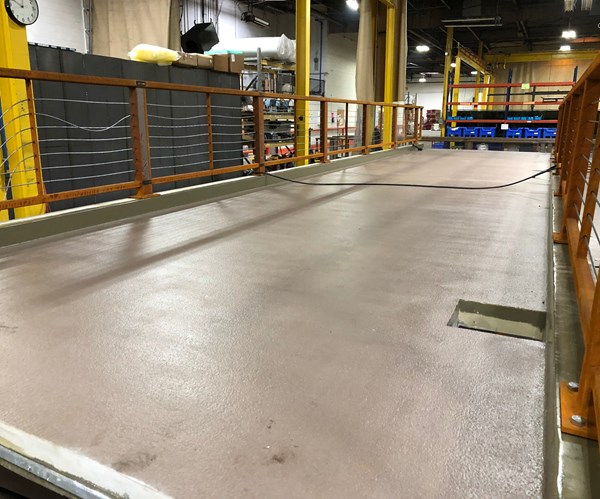
This bridge panel fabricated by Composite Advantage is destined for a shared-use path along Nevada’s State Route 28 along Lake Tahoe.
According to Scott Reeve, president and CEO of Composite Advantage, a solution was needed that could be installed on uneven, rocky terrain. Also, Nevada’s State Route 28 provides the only access to a particular section of the Lake Tahoe coastline, so shutting down the road to pour concrete wasn’t a good option — the right solution would also need to afford quick installation.
“Environmental conditions and traffic concerns dictated a lightweight, prefabricated product,” says Reeve.
Composite Advantage’s FRP bridge deck product was chosen for the job. During the plant tour, CW got a peek at some of the panels in the making.
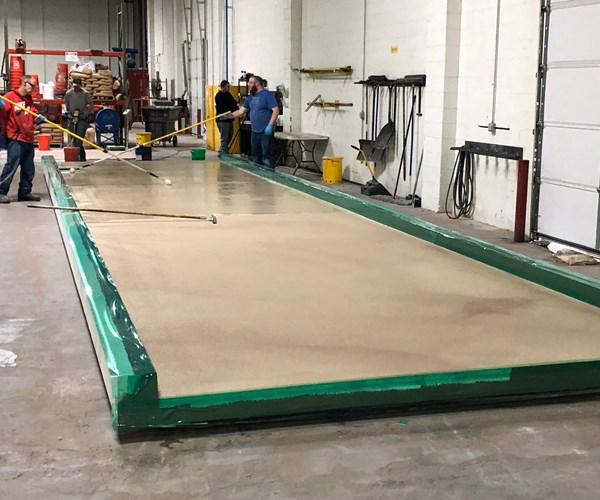
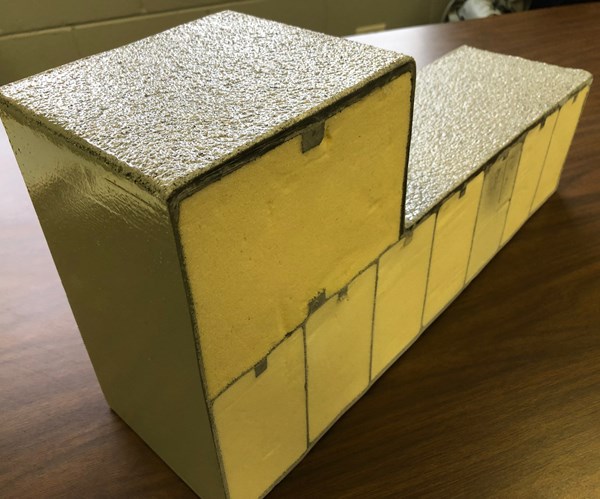
A cross-section of a Composite Advantage bridge deck panel shows the sections of lightweight core material that are encased in glass-fiber fabric and then infused with vinyl ester to create a section of FRP bridge decking.
In addition to the bridge decks, Reeve also explained the company’s work with waterfront structures. Composite Advantage’s offerings include composite pilings, fender systems and camels (which are bumpers that protect naval vessels).

“Our pilings are the ‘fence posts’ that support wales or guard rails in a fender system,” explains Reeve.
He indicated that piling systems are an area where FRP can make a huge difference, not just in terms of weight savings and corrosion resistance, but in terms of cost.

“We’re able to fabricate our pilings with a high strength-to-weight ratio which means we can make a very structurally efficient pile,” says Reeve. In a recent project in New Jersey’s Cape May Peninsula, the company’s FiberPILE FRP system was able to cut the number of piles needed for the structure in half, thereby offering cost savings. Composite Advantage met the necessary 250 kip-foot energy absorption impact load using 53 composite piles, ultimately replacing 141 original wooden piles.
The role of composites in infrastructure is at an interesting point. In August of 2018, bipartisan legislation was introduced in the U.S. aimed at encouraging research and use of innovative materials for infrastructure projects. Known as the Innovative Materials for America’s Growth and Infrastructure Newly Expanded (IMAGINE) Act, the bill seeks to lead decision makers involved in construction and infrastructure projects to consider innovative materials as an option. By educating about the benefits and properties the materials offer, infrastructure projects might be envisioned with the right material for the job.
With its experience working to offer solutions like FRP bridges and waterfront structures that offer high strength, corrosion resistance and improved material lifetime, Reeve says Composite Advantage is involved in those discussions in Washington D.C. and efforts to educate decision makers about the benefits of composites. And in the meantime, they’re creating and rehabilitating structures that stand the test of time. One might say Composite Advantage is a company working to build bridges in more ways than one.
Check out Composite Advantage’s blog post about the visit for more insights.


Related Content

UNIST develops CFRP droplet-based electricity generator
Researchers have validated the S-FRP-DEG system’s ability to accurately convert the impact of falling rain into electrical signals, achieving an autonomous power source for drainage control.
Read More
Pultron Composites GFRP rebar addresses facility, marina project challenges
The company’s Mateenbar GFRP rebar has led to more durable solutions for production of a new medical research center, and to improve structures regularly exposed to harsh marine conditions.
Read More
EuReComp team highlights ROCCA Cabin demonstrator for EOL composites
The ROCCA Cabin serves as a proof of concept for how large composite parts, often destined for disposal, can re-enter the value chain as architectural elements with both functional and aesthetic value.
Read More
Norco GFRP molds meet high-quality cast concrete beam production needs
A project with P&M successfully achieved manufacture of six 20-meter-long architectural beams for an R&D facility with near-seamless surfaces and on a tight production schedule.
Read MoreRead Next

Robotic computed laminography brings X-ray CT resolution to large composite structures
Omni NDE collaborative robots, X-ray end effectors and Voxray’s reconstruction approach enables 5-micron inspection of aerospace parts without size constraints.
Read More
Composite trends gaining industrial traction for 2026
Startups & Investors topics over the last year show the industry is rapidly gaining maturity while benefiting from macro-trends in circularity, AI and TPC and high-rate manufacturing, all potential gains for investors.
Read More
From PMCs to sandwich composites: Tracing the path of test method standardization
Over the decades, progression of PMC and sandwich composite test method development and standardization has been shaped by the requirements of the composites industry.
Read More