
Not your average carbon fiber part
A Swedish industrial designer and artisan, Ragnar Friberg, contacted CW recently about a new project: a one-of-a-kind custom champagne glass and an accompanying storage cabinet that incorporates carbon fiber — along with a number of high-end materials.

Share


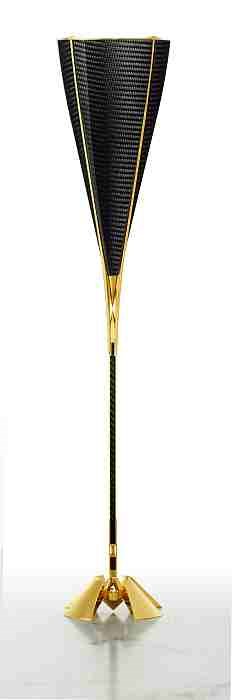
This exclusive champagne glass and protective cabinet, incorporating carbon fiber/epoxy, comes from Swedish designer Ragnar Friberg.
A Swedish industrial designer and artisan, Ragnar Friberg, contacted CW recently about a new project: a one-of-a-kind custom champagne glass and an accompanying storage cabinet that incorporates carbon fiber — along with a number of high-end materials including diamonds, gold, porphyry stone and black oak wood from the 15th Century. The founder of the design firm RAF (Stockholm), Friberg tells us that his years of experience with composites in power boat racing, where he constructed his own boats, led him to eventually build a business where he combines carbon fiber with other fine materials to make beautiful, exclusive yet useful articles.
Friberg envisioned a 305 mm-tall champagne flute with a carbon fiber/epoxy cup combined with a gold stem ornamented with inlays, on an 18K solid gold base. The entire glass weighs 190 grams, with the base weighing 100 grams, “to balance the cup when it’s been filled with champagne,” says Friberg. He explains that the cup was made with 6 plies of a 1k 2x2 woven twill, 150 grams per square meter (gsm) and 1 mm thick, with the fabric supplied by textile weaver C. Cramer & Co. (Heek, Germany). The fabric was wet out with an epoxy supplied by Huntsman Advanced Materials (The Woodlands, TX, US). Friberg explains that he rejected prepreg because “It looked too perfect, too sterile. I wanted to add a blue color to the epoxy resin, so that the cured cup and stem inlays would be faintly blue.” The biggest challenge was applying the gold leaf. After wetting the first ply with resin, he placed the gold leaf onto the wet-out fabric on a vacuum table, he explains: “I had to get the gold leaf to really sink into the fiber weave, and the vacuum helped in that regard.” Placing the gold-treated ply in the mold was also tricky, to avoid air entrapment and cracking of the very thin gold layer. After nearly 100 attempts to get the gold layer as he wanted it, Friberg says he switched to an epoxy with higher flexibility, which prevented cracking in the gold. To ensure the integrity of the gold/carbon bond, the cup was molded in two halves, with the inner 3 plies (including the gold) molded around an conical aluminum mandrel, and the outer three plies placed in a matching female mold. The entire layup was oven-cured at 60°C for 16 hours.

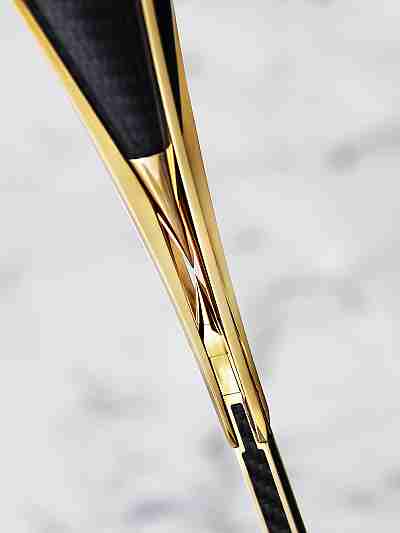
The cup is supported by four gold legs, which dovetail into the stem, which has carbon fiber inlays.
After demolding, the cup halves were bonded together (with seams offset by 90°), and the cup was sanded, clear-coated and polished. The photos show how the bottom of the cup is finished with an adhesively-bonded cast gold cone. Four thin, solid gold legs were glued to the cup’s exterior; the legs extend down past the cone to the square stem, where they are attached via dovetailed slots. The stem combines more carbon/epoxy, 15th Century black oak and lizard skin inlays over solid 18K gold; the stem in turn is fastened to the gold base with 4 gold screws. Three diamonds totalling 2.09 carats are part of the flute, including one that is set inside the cup at the bottom. Says Friberg, ”The diamond inside stimulates the champagne bubbles and boosts the bouquet.”
The cup is made with a 1K carbon twill, with gold leaf applied to the cup's inner surface before cure.
The hefty 8 kg, 450 mm-high cabinet exists to hold and protect the glass. It is a combination of gold, porphyry stone, lizard skin and silk. All together, Friberg estimates that more than 1000 hours have gone into making the glass and cabinet, which, when offered to the market, will command approximately $120,000. When asked what motivates his work, Friberg says that he got interested in composites in the 1990s and has been working on projects that would showcase carbon fiber ever since: “I came up with the idea to make something really nice — to make a truly beautiful thing is worth trying.” Friberg's web site (rafstockholm.com/index.html) has more photos and other products as well.


Related Content

Composites end markets: Automotive (2025)
Composites manufacturing intelligence drives circular economy solutions as automotive industry balances technical demands with sustainability mandates.
Read More
Revolutionizing space composites: A new era of satellite materials
A new approach for high volumes of small satellite structures uses low-CTE, low-cost CFRP cellular core, robust single-ply skins and modular panel systems to cut lead time, labor and cost for reflectors, solar arrays and more.
Read More
An outlook on China’s carbon fiber market
This analysis sheds additional light on the insights, observations and data shared in ATA Industrial Group’s carbon fiber market report on global and Chinese industry players.
Read More
Co-molding SMC with braided glass fiber demonstrates truck bed potential
Prepreg co-molding compound by IDI Composites International and A&P Technology enables new geometries and levels of strength and resiliency for automotive, mobility.
Read MoreRead Next

Dialing in composites performance via dynamic digital twins
Sport Dynamics Lab uses Flexdynamics testing, digital models and AI tools to compare designs, materials and systems, enabling optimization with potential for propellers, drones and vibrational structures.
Read More
Industrial ultrasonic NDT adaptation permits accessible composite bicycle inspection
Cycle Inspect's ASNT-aligned certification program employs affordable twin-crystal ultrasonic testing equipment and standardized inspection methods to detect damage in composite bicycle components.
Read More
Post Cure: 3D printed plastic, composite mouthstick designs assist limited-mobility users
Three M Tool and Machine has used its in-house additive manufacturing capabilities to rethink medical devices like mouthsticks, which must be stiff, lightweight and comfortable enough for everyday use.
Read More


