
KraussMaffei doubles pultrusion speed and continued developing composites processes for large series production
New iPul pultrusion system doubles production speed while intelligent automation cuts cycle time in FiberForm and RTM processes.

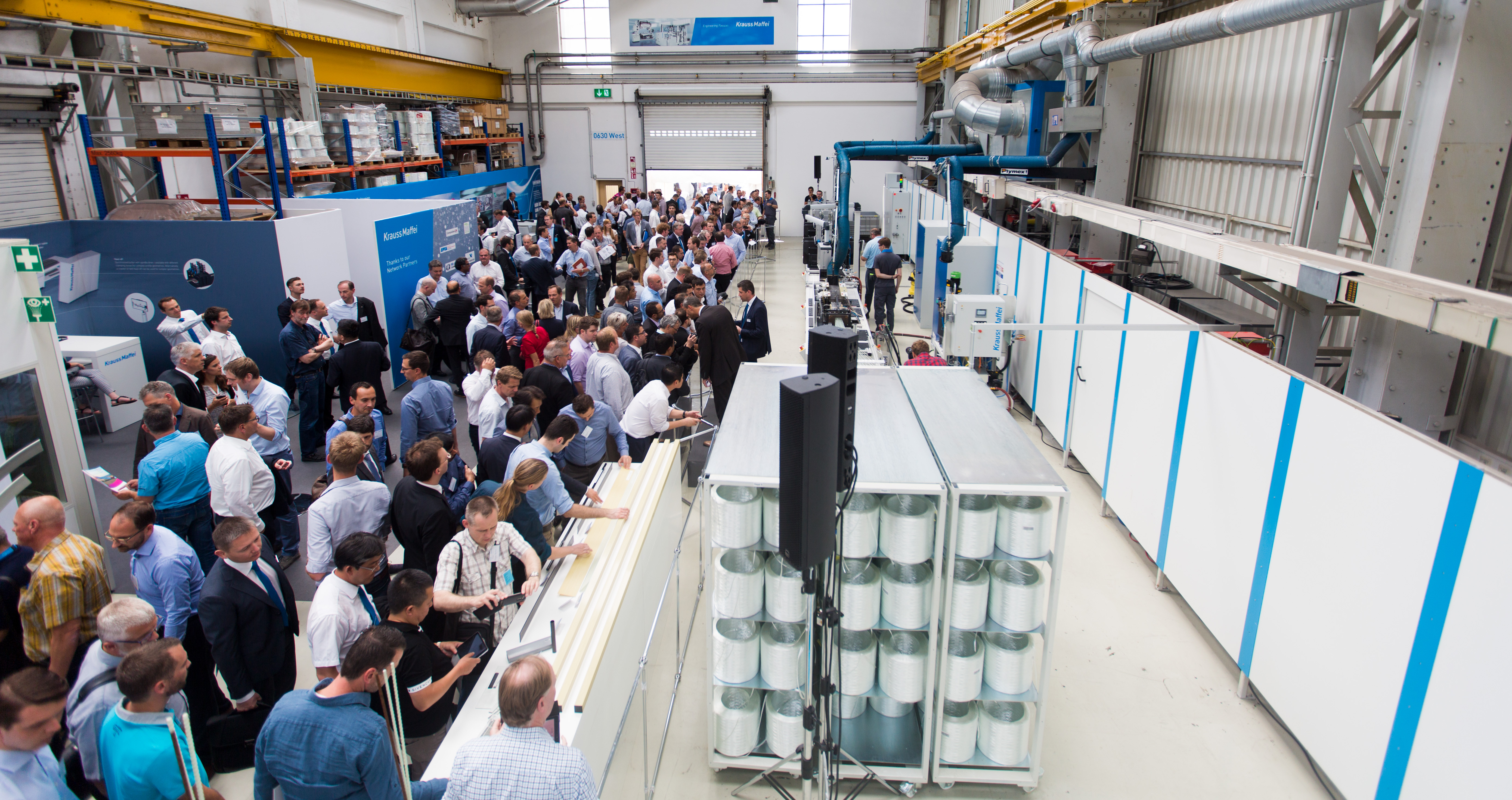
The new iPul system at the KraussMaffei Competence Day Pultrusion.
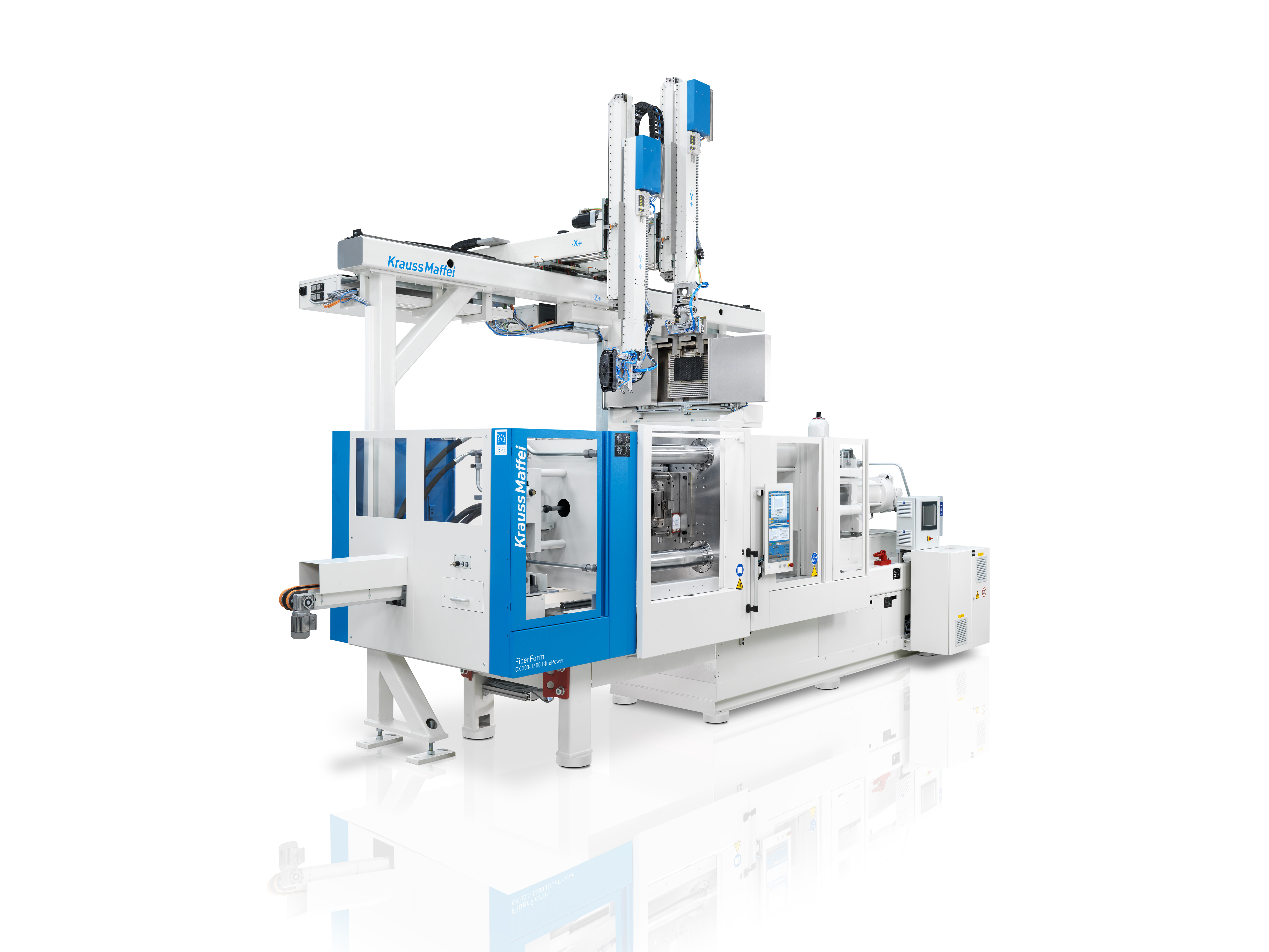
KraussMaffei has further perfected its FiberForm process.


Krauss-Maffei’s (Munich, Germany) new iPul system had its successful live debut during the KraussMaffei Competence Day Pultrusion at the end of June. The new iPul pultrusion system is the first complete system for continuous pultrusion of straight and curved profiles. Featuring production speeds up to two times faster than the conventional tub or pull-through process, it opens up completely new markets for pultrusion.
In pultrusion, continuous glass, carbon or aramid fibers are infiltrated with a reactive plastic matrix and formed to the desired profile in a heated mold. Grippers pull the cured profile continuously and feed it to a sawing unit. KraussMaffei’s new iPul system encompasses this entire sequence, revolutionizing long-time pultrusion technology in two respects. It encapsulates the infiltration of the fibers — which, until now, has mostly occurred in open vessels — in a closed injection box, which permits the use of fast-reacting systems including epoxy, polyurethane and polyamide 6. And it increases the production speed from the usual 0.5 - 1.5 m/min to approximately 3.0 m/min.


Thermoplastic lightweight construction is up and coming
KraussMaffei has also continued to develop its other composite processes, such as FiberForm, which thermoforms and overmolds organosheet – i.e., semifished thermoplastic composite products with continuous glass, carbon or aramid fibers that are embedded into a thermoplastic matrix such as polyamide (PA), polypropylene (PP), etc. In this process, these semifinished products are first heated, reshaped in the injection mold and then back-injected with polymer, with or without fiber reinforcement.
"Since the market launch at the K 2010, we have consistently further developed the FiberForm technology, and today we offer our customers a series production solution," explains Stefan Fenske, FiberForm Technology Manager with KraussMaffei. New for the KraussMaffei FiberForm system is, for example, the concept of automation. The heating of the composite sheet and the demolding of the finished component take place in parallel, and the individual process steps are thus decoupled from one another. In addition, the infrared heating station required for heating up has been mounted directly above the mold parting line and—as a result—the transfer time of the composite sheet into the injection mold is reduced to a minimum. Overall, the FiberForm system provides its users with extremely robust processes, high availability and the efficiency required for high-volume series projects.
Five different RTM processes
Also continuously improved for short cycle times, high reproducibility and a high degree of automation are KraussMaffei’s five different resin transfer molding (RTM) processes. High pressure RTM (HP-RTM) allows the manufacture of extremely lightweight structural components that also withstand requirements such as extreme dynamic load conditions in a car crash. In compression RTM (C-RTM), the addition of resin — usually epoxy or polyurethane — is carried out in a slightly open mold, yielding parts with over 50% fiber content but with a paintable surface. Wet pressing does not inject resin, but instead uses a simplified process chain—the preform process is completely omitted – applying resin directly onto reinforcements which are subsequently pressed, and offers a cost-effective alternative for manufacturing high-volume, lightweight vehicle components. The thermoplastic RTM (T-RTM) injects thermoplastic matrix systems, including very low-viscosity monomers such as caprolactam, which then in situ polymerizes to form a PA6 (Nylon 6) composite. Advantage: The components are recyclable at the end of the product life cycle and, unlike common thermoset plastics, can also be formed or welded in downstream process steps.


Related Content

Composite Conductor Cores Boost Capacity, Cut Cost to Help Power Grids Meet AI Demand
Composite cores have evolved to increase conductor capacity 2X and cut transmission losses by up to 50%, achievable within 1-3 years with existing infrastructure, but also enable sensing and smart, adaptive grids.
Read More
Exel GFRP tubes improve QHeat geothermal energy storage
Installation of pultruded composite underground collector pipes have greatly enhanced the energy efficiency of Qheat’s geothermal wells.
Read More
Avient, ReForm Composites accelerate TPC adoption in construction
ReForm’s pultrusion technology with Avient’s composite materials enables curved continuous fiber TPC profiles demonstrated in the PolyDowel infrastructure project.
Read More
KraussMaffei portfolio supports composites fabricators from development to series production
JEC World 2026: Equipment supplier displays long fiber injection + wet pressing, RTM, ColorForm, FiberForm, NFPP, pultrusion, 3D printing of high-performance plastics exhibit.
Read MoreRead Next

Post Cure: 3D printed plastic, composite mouthstick designs assist limited-mobility users
Three M Tool and Machine has used its in-house additive manufacturing capabilities to rethink medical devices like mouthsticks, which must be stiff, lightweight and comfortable enough for everyday use.
Read More
Report: Composites and Carbon Fiber Use in Hydrogen Storage
A first-of-its-kind technical report that assesses the materials, manufacturing processes, market and energy trends driving use of carbon fiber composites in global hydrogen (H₂) storage applications for fuel cell-powered trucks, buses, trains and passenger vehicles.
Read More
Dialing in composites performance via dynamic digital twins
Sport Dynamics Lab uses Flexdynamics testing, digital models and AI tools to compare designs, materials and systems, enabling optimization with potential for propellers, drones and vibrational structures.
Read More


