
Electric power for aircraft on the horizon
As a general aviation enthusiast and co-pilot — my husband and I fly a Mooney on occasion — I have been closely following the news about the Solar Impulse plane and the team’s historic round-the-world flight, on solar power alone.


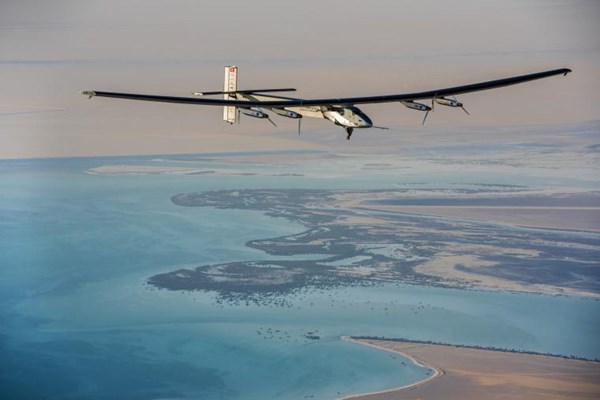
Solar Impulse successfully completed its round-the-world flight this week.
As a general aviation enthusiast and co-pilot — my husband and I fly a Mooney on occasion — I have been closely following the news about the Solar Impulse plane and the team’s historic round-the-world flight, on solar power alone. In case you’ve missed this news, Bertrand Piccard and Andre Borschberg started an epic demonstration in Abu Dhabi back on March 9, 2015, and successfully completed 17 legs and 40,000 km in their solar-powered electric Solar Impulse 2 aircraft and returned to their starting point this week, on July 26. The trip took much longer than expected, because the 5-day crossing of the Pacific from Nagoya, Japan to Hawaii caused damage to the aircraft’s batteries, necessitating a long 9-month layover in Honolulu for repairs. The aircraft of course employs composite materials, as CW has pointed out in some past articles, including this one: http://www.compositesworld.com/articles/solar-impulse-2-pulse-on-the-future. CW’s Heather Caliendo was on hand when the plane landed in Phoenix, during its North American legs: http://www.compositesworld.com/blog/post/up-close-and-personal-with-solar-impulse-2.
Piccard and Borschberg’s achievement coincides with several items I’ve noticed over the past couple of days. First, this week marks the Experimental Aviation Assn.’s (EAA) AirVenture air show in Oshkosh, WI, US, often the setting for news and trends. Airbus is there exhibiting its E-Fan aircraft for the first time in the US. The E-Fan was first introduced at Farnborough Air Show in 2014, and the all-electric plane crossed the English Channel in 2015. The version in Wisconsin this week is E-Fan version 1.2, which incorporates a hybrid electric/gasoline engine on display for the first time. Airbus has teamed with Siemens to develop this hybrid concept and eventually scale it up for viable commercial application. According to a Siemens press release, the CEOs of both companies, Tom Enders and Joe Kaeser, endorse a major joint project towards the electrification of aviation with the goal of demonstrating the technical feasibility of various hybrid/electric propulsion systems by 2020. A team of around 200 employees will be working on this project to develop electrically-powered aircraft. This strikes me as pretty big news.


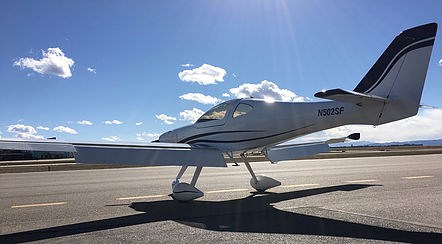
AEAC's Sun Flyer is on display this week at the Oshkosh air show.
And they’re not the only ones developing electric power for aircraft. As just one example, a company here in Colorado unveiled two months ago the Sun Flyer, and it’s also on display this week at Oshkosh. Developed by Aero Electric Aircraft Corp. (AEAC) headed by well-known engineer pilot George Bye, the Sun Flyer is targeted to training schools and bringing down the cost of flying — the cost of a gallon of leaded fuel for conventional aircraft like our Mooney is currently priced at about $5 per gallon, which adds to the steep price of flight training and, some say, the dearth of student pilots. Bye claims that energy cost for an hour in his aircraft could be as little as $1. That could really change the general aviation landscape.
Then, the US Environmental Protection Agency (EPA) announced Monday that it will impose emissions limits on US commercial aircraft, along the lines of a United Nations recommendation announced in February for international flights. Those limits require a 4% reduction in fuel consumption during cruise, beginning in 2020. And Europe’s Clean Sky public/private partnership program has been looking for years at breakthrough technology to reduce aircraft emissions.
It seems to me that all of this is pointing toward a shift in aviation, mirroring what has happened in the automotive sector: Planes, like cars, are being pulled into a new realm of lighter weight materials and alternative, even renewable, power sources, to meet increasingly more stringent emission targets. Composites, of course, have a place in this new scheme, so it’s a trend that may ultimately benefit our industry. And it would certainly make a ride in our airplane a lot quieter…


Related Content

Plant tour: Hexagon Purus, Kassel, Germany
Fully automated, Industry 4.0 line for hydrogen pressure vessels advances efficiency and versatility in small footprint for next-gen, sustainable composites production.
Read More
JEC World 2024 highlights: Glass fiber recycling, biocomposites and more
CW technical editor Hannah Mason discusses trends seen at this year’s JEC World trade show, including sustainability-focused technologies and commitments, the Paris Olympics amongst other topics.
Read More
Bladder-assisted compression molding derivative produces complex, autoclave-quality automotive parts
HP Composites’ AirPower technology enables high-rate CFRP roof production with 50% energy savings for the Maserati MC20.
Read More
Composites end markets: Sports and recreation (2025)
The use of composite materials in high-performance sporting goods continues to grow, with new advancements including thermoplastic and sustainability-focused materials and automated processes.
Read MoreRead Next

Ceramic matrix composites: Faster, cheaper, higher temperature
New players proliferate, increasing CMC materials and manufacturing capacity, novel processes and automation to meet demand for higher part volumes and performance.
Read More
Next-gen fan blades: Hybrid twin RTM, printed sensors, laser shock disassembly
MORPHO project demonstrates blade with 20% faster RTM cure cycle, uses AI-based monitoring for improved maintenance/life cycle management and proves laser shock disassembly for recycling.
Read More
Ultrasonic welding for in-space manufacturing of CFRTP
Agile Ultrasonics and NASA trial robotic-compatible carbon fiber-reinforced thermoplastic ultrasonic welding technology for space structures.
Read More