
Composite rebar strengthens riverbed “catfish houses”
Basalt-reinforced polyester rebar eliminates rust and spalling and extends the useful life of concrete catfish spawning and habitat units in Chicago River environmental restoration effort.

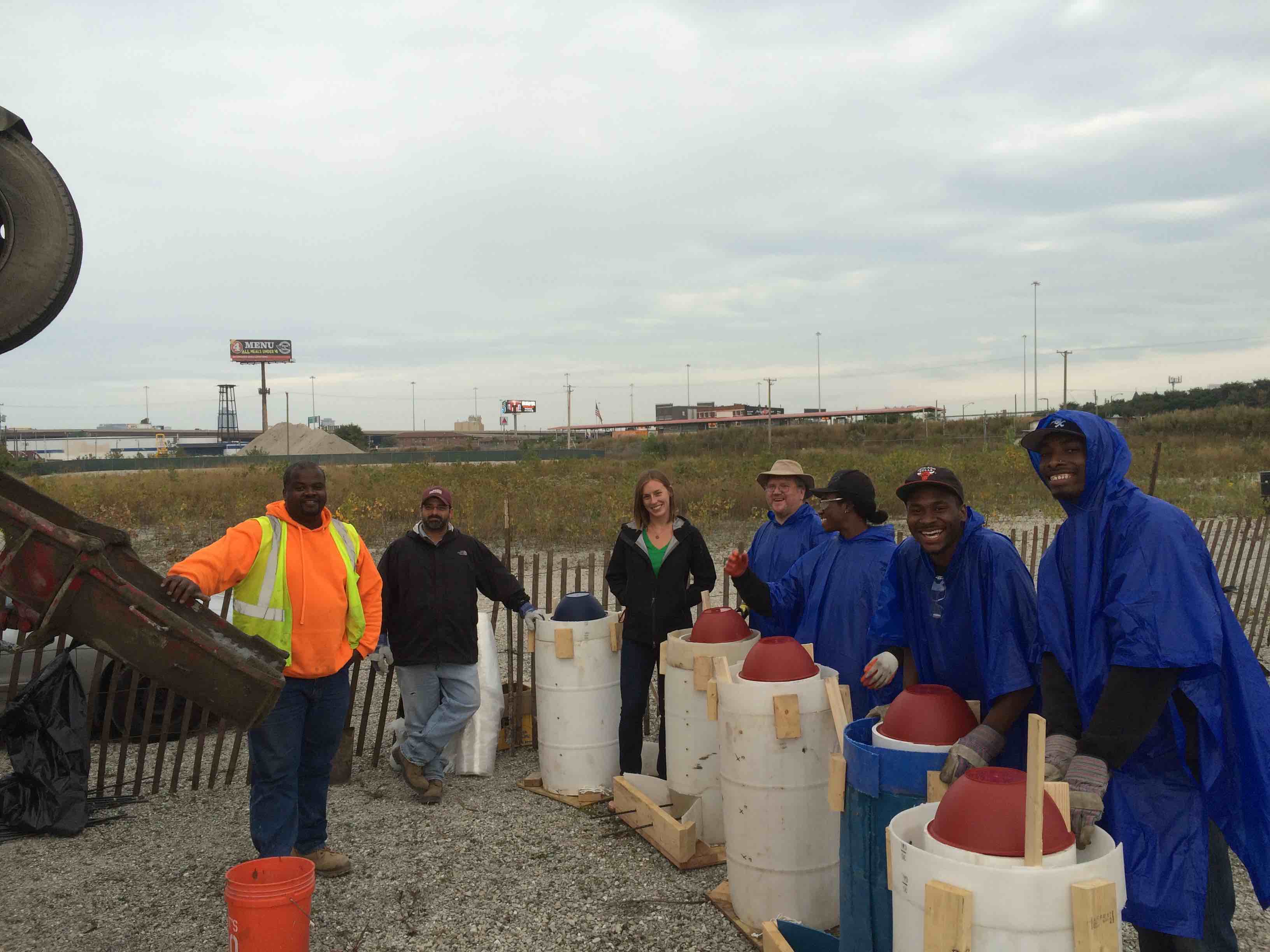
Composites promote conservation: To encourage the return of catfish to the Chicago River, representatives of conservation group Friends of the Chicago River, the Illinois Department of Natural Resources, Urban Habitat Chicago, Ozinga RMC, students representing several other Chicago non-profits, and Asimow Landscaping gathered to produce 50 demonstrator fish habitat and spawning units (FHSUs). Source: Ozinga RMC Inc.
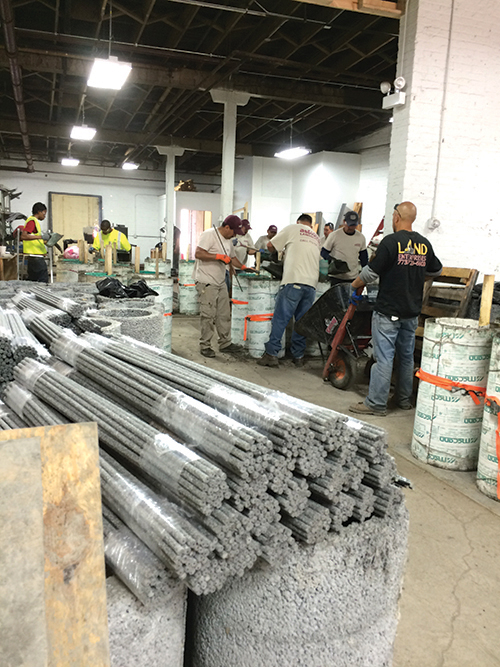
Rebar reinforced with basalt fiber: The FHSUs, affectionately called “catfish houses,” were formed by Urban Habitat Chicago crews using Ozinga’s Filtercrete pervious concrete reinforced with composite rebar (unsaturated polyester resin reinforced with basalt rovings supplied by RockWerk Systems Inc.). The project also helped at-risk and disadvantaged Chicago youth gain useful and interesting real-world experience while helping improve the health of the Chicago River. Source: Ozinga RMC Inc.
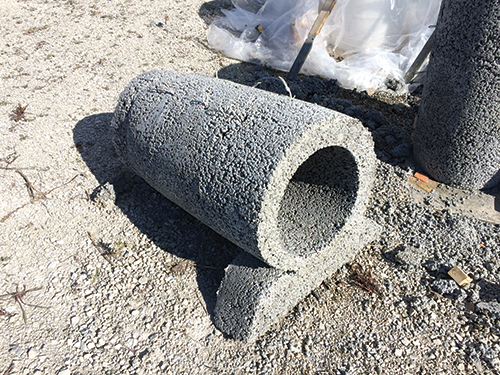
Generational improvements continue: Generation 1 FHSUs (below) featured an integral concrete “foot” designed to keep the end farthest from the stream bank off the bottom of the riverbed so it didn’t fill up with sediment. Rebar was allowed to protrude through these feet to anchor them into the riverbank, preventing units from moving once installed. Those heavy units, however, proved difficult to move and handle (see next photo). Source: Ozinga RMC Inc.
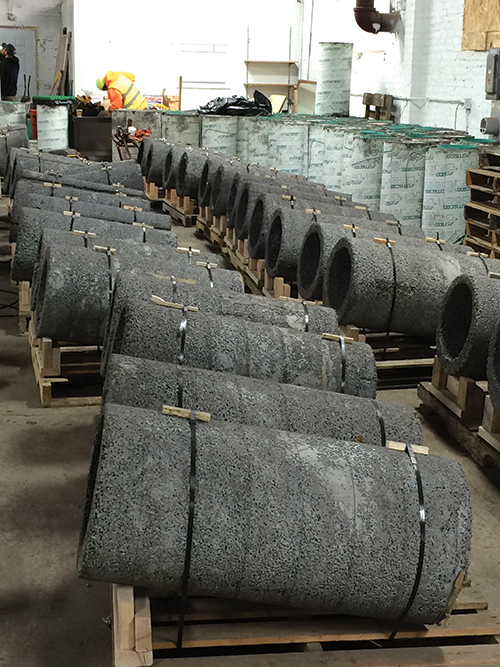
Generational improvements continue: A second-generation FHSU design, built in spring 2015, used lighter aggregate, eliminated the concrete foot, and paired 2 FHSUs with wooden risers banded to wooden pallets. Significantly lighter, the new design also had its issues and it, too, likely will be modified. Source: Ozinga RMC Inc.


More than a century of engineering effort has made the Chicago River — a 251-km long system of rivers and canals that snakes through urban Chicago, IL, US — into what the American Society of Civil Engineers (ASCE, Reston, VA, US) today considers a “civil engineering monument of the millennium.” One result? Water quality has improved dramatically in the past 30 years, according to Margaret Frisbie, executive director of the Chicago-based conservation group Friends of the Chicago River (Friends). A downside, however, is that in many areas of the system, the downed trees and natural riverbanks that created good fish habitat and would ordinarily be present have been replaced with concrete seawalls, thus preventing the return of healthy fish populations to the now improved river environment. To address the loss of fish habitat and encourage healthy repopulation, Friends worked with the Illinois Department of Natural Resources (IDNR) to design nesting cavities for channel catfish, a native species that surveys had shown should be more abundant in the system. The simple cavity design mimicked an underwater hollow log. It was designed using 31-cm-diameter PVC pipe cut to 81-cm lengths and attached by steel cables to concrete blocks to weigh the pipes down and keep them on the bottom of the river. The plan was to install 400 fish habitat and spawning units (FHSUs), introduce 100,000 baby channel catfish, donated by IDNR, that would mature in the river and, ultimately, see them use the FHSUs as nesting cavities.
Before FHSU production began, Friends had an opportunity to consult with Brian Lutey, VP – sustainability at Ozinga Green Building, a division of Ozinga Bros. Inc., a Chicago-based builder and concrete supplier. He examined the initial FHSU design and suggested that there was a better way to make them.


Lutey is active on the board of another non-profit called Urban Habitat Chicago (UHC, Chicago). The group’s mission is to demonstrate the viability of green infrastructure, urban agriculture and materials reuse/recycling, and to work with disadvantaged and at-risk youth. He knew a microbiologist and fish expert from that board, so they met to discuss the needs of catfish and the possibility of using Ozinga’s Filtercrete “pervious” concrete in FHSUs.
Pervious concrete is fairly porous. Thanks to use of the chunky aggregate that creates pores in its finished structure, it’s often used in parking lots of green buildings to encourage rainwater to infiltrate soils rather than run off to overloaded storm drains. The biologist already knew that pervious concrete’s pores help to clean water by trapping large particles (mechanical filtration) and by providing habitat for microbes and invertebrate colonies, which eat organic matter (chemical filtration) and, in turn, are eaten by fish fry (baby fish) and larger vertebrates. The pores also would help reduce the structure’s mass.
Because the FHSUs were intended as permanent installations, that’s where composites entered the picture. In an aquatic environment, steel rebar would quickly rust and contribute to premature unit failure, but Lutey knew composite rebar would resist corrosion and withstand long-term underwater exposure to freeze/thaw cycles. To find a source of composite rebar, Lutey turned to Dr. Mohsen Issa, Ph.D., P.E., S.E., professor of structural and civil engineering at the University of Illinois – Chicago, who is well known for his work on high-performance concrete and rapid bridge replacement. Issa put Lutey in touch with RockWerk Systems Inc. (Naperville, IL, US), which was working with composites consultancy Allied Composite Technologies LLC (ACT, Rochester Hills, MI, US) to develop North American-produced basalt-reinforced composite rebar.
“We’ve been working with Dr. Issa for about 10 years on different types of basalt rebar,” explains RockWerks partner, Jack Rigsby. “I brought the first composite rebar over from Russia 12 years ago when I was head of R&D at Dukane Precast [Naperville, IL, US]. Dukane built the first building in the US I’m aware of that was reinforced in key sections with basalt rebar for Argonne National Laboratory [Lemont, IL, US]. They needed a building free of steel because their equipment created magnetic fields around anything ferrous, which affected their readings. When we tested basalt rebar, we found it was three times stronger than steel, easy to install and didn’t rust, so we asked ourselves ‘why aren’t we using it here?’”
Tony Celucci, another RockWerk partner adds, “We’ve had Dr. Issa test basalt rebar from many manufacturers to check product consistency, quality and fiber content across various sizes of rebar. We found they varied dramatically — from 60% to 83% fiber in some cases. Since there didn’t seem to be any established standard for quality control, we decided to partner and establish a strategic supply chain where we could control everything from rock to finished product.” In addition to ACT, RockWerk currently is partnered with basalt rovings producer Mafic SA (Kells, Ireland), resin supplier Ashland Inc. (Columbus, OH, US) and an unnamed pultruder. RockWerk arranged to supply #3 (10-mm diameter) basalt-reinforced unsaturated polyester rebar to Lutey for the project.
Generation 1 into the water
After evaluating nine FHSU prototypes, the team was ready to make its first production batch in fall 2014. Ozinga supplied pervious concrete, and labor was provided by UHC staff plus youth from two other Chicago-based non-profits: Empowerment through Education & Exposure (EEE), which exposes underprivileged youth to educational opportunities and activities that build knowledge and skills; and BUILD Chicago Inc., which works with at-risk and gang-involved youth to develop alternative lifestyles. Additionally, UHC president, Larry Asimow, owner of Larry Asimow Landscaping Inc., a local landscape contractor, agreed to provide extra labor and construction equipment.
Because one of UHC’s missions is to promote materials reuse/recycling, the team used a lot of “found” materials to produce the FHSUs. Donated 208L plastic drums became the outer “mold” (form) for the concrete and cardboard concrete forms formed the hollow center. The latter didn’t prove durable enough, so the team switched to PVC pipe that was split lengthwise to allow a wooden strip to be inserted. A plastic ball sealed off the top of the pipe so concrete didn’t get into the center opening when it was poured into the barrel. During the forming process, polymer-based rope loops were pushed through the structure’s walls to form anchors for fans of geotextile “kelp,” which also was bonded in place with plastic sealer and foam.
Each FHSU used four lengths of composite rebar and featured a separate concrete “foot” designed to keep the end farthest from the stream bank up off the riverbed so it wouldn’t fill with sediment. A soybean-based sealer/curing/release agent for the pervious concrete (The Bean, C2 Products Inc., Arcadia, IN, US) was used, and each unit was wrapped in a plastic bag to help speed cure by ensuring the concrete didn’t dry out. When the concrete was fully cured, the wooden strip was removed, which provided space to pull out the PVC pipe. The first units weighed 163-181 kg and measured 0.91m long, with an outside diameter of 46 cm, an inside diameter of 34 cm and 5.1 to 6.4-cm-thick walls. Lutey reports they achieved an extremely robust cure. “You could hit the FHSUs with a hammer and the concrete wouldn’t break,” he recalls.
The first 50 units were trucked to preselected sites, lifted by boom onto a barge, and set onto the river bottom by a team from Friends and IDNR just before the river froze. By that time, Friends and IDNR had already released 55,000 channel catfish fry into the river.
Lighter Generation 2 deployed
This May, IDNR and Friends surveyed the pilot site via underwater camera and found that the FHSUs hadn’t moved or sunk into the riverbed, so the team moved forward with plans to make another 350 units this spring and summer. Since then, 100 units have been produced and installed, but with design changes to improve handling and stability. The geotextile kelp was eliminated and the concrete foot was replaced by wooden risers. To reduce weight so FHSUs were easier to transport, the concrete was modified with a lighter aggregate, reducing unit mass to about 100 kg. This time, FHSUs were lashed, several feet apart, to wooden pallets in pairs before they were placed into the river. The thinking was this would keep the fish houses from sinking into the silt should the riverbed erode. (The pallet wasn’t expected to rot very quickly since the water is fairly anaerobic.) However, this design also proved challenging because the pallets tended to flip over in the water, and banding that held the FHSUs to pallets could loosen. “This is an evolving project,” concedes Lutey. “The design is still changing.”
Friends and IDNR have since released the remaining 45,000 catfish fry plus an additional 100,000 to help build a strong population. Frisbie notes that the IDNR does fish surveys across the state on a rotating basis and will check progress in areas where FHSUs have been placed in about three years. “It’ll be a little while before we find out how the catfish are doing, but hopefully, the FHSUs turn out to play a strong role in their return.”


Related Content

Exel Composites adopts bio-based UPR resin at commercial scale
Purchase of Polynt bio-based resin delivers 20% cut in CO2 footprint for composites manufacturers, builds Exel’s efforts to give customers more sustainable options.
Read More
JEC World 2025 highlights: Evolving recycling and biomaterials technologies
CW technical editor Hannah Mason shares sustainability-focused composites trade show highlights featuring maturation, scale-up, new partnerships, and new technologies in biomaterials and recycling.
Read More
PUR composite sandwich panels for 3D automotive parts, high-volume panels and more
At its U.S. sites, Ascorium produces glass fiber/PUR 3D parts via semi-automated molding, high-volume flat panels via a continuous line while working toward bio-based PUR and recycling.
Read More
Next-gen fan blades: Hybrid twin RTM, printed sensors, laser shock disassembly
MORPHO project demonstrates blade with 20% faster RTM cure cycle, uses AI-based monitoring for improved maintenance/life cycle management and proves laser shock disassembly for recycling.
Read MoreRead Next

Industrial ultrasonic NDT adaptation permits accessible composite bicycle inspection
Cycle Inspect's ASNT-aligned certification program employs affordable twin-crystal ultrasonic testing equipment and standardized inspection methods to detect damage in composite bicycle components.
Read More
Dialing in composites performance via dynamic digital twins
Sport Dynamics Lab uses Flexdynamics testing, digital models and AI tools to compare designs, materials and systems, enabling optimization with potential for propellers, drones and vibrational structures.
Read More
Report: Composites and Carbon Fiber Use in Hydrogen Storage
A first-of-its-kind technical report that assesses the materials, manufacturing processes, market and energy trends driving use of carbon fiber composites in global hydrogen (H₂) storage applications for fuel cell-powered trucks, buses, trains and passenger vehicles.
Read More


