
Huntsman Advanced Materials resin systems meet composite pressure vessel requirements
Araldite resin systems cover wet and towpreg filament winding and RTM manufacturing processes for increased productivity and greater part consistency.


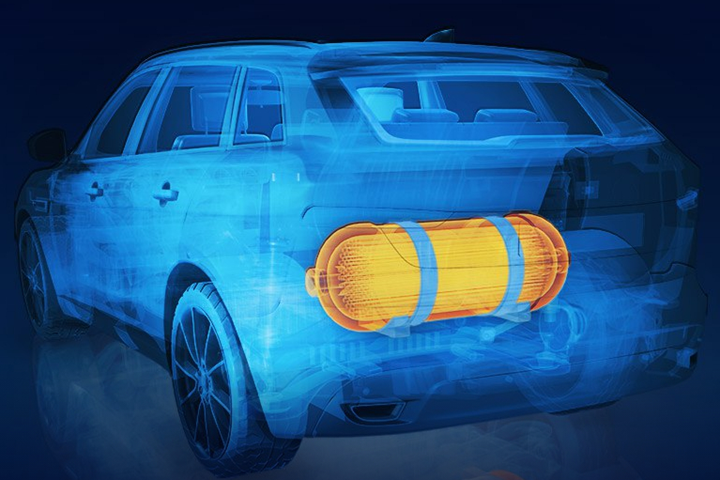
Photo Credit: Huntsman Corporation
According to Huntsman Advanced Materials (The Woodlands, Texas, U.S.), as hydrogen roadmaps and investments grow and enter new applications, hydrogen storage in pressure vessels will become a critical enabler for wide-scale adoption and the subject of intensive research and development. To further this progress, the company has developed the Araldite range for filament-wound composite pressure vessels. Encompassing high-performance epoxy, acrylic, polyurethane adhesives, high-performance specialty epoxy and benzoxazine resin systems, Araldite is said to be able to meet the stringent requirements for hydrogen storage. This includes pressure testing, impact resistance, chemical exposure and other temperature and pressure cycling tests and regulations.
According to Huntsman, while the pressure resistance of hydrogen vessels is mainly governed by the fiber reinforcement, the resin matrix plays a key role in providing environmental exposure protection (thermal, chemical, impact) as well as fatigue/pressure-cycling resistance to withstand the filling and emptying cycles. Table 1 below shows three examples of high-performance epoxy-based systems that offer a combination of thermal resistance, high mechanical strength, high elongation at break and high fracture toughness.


|
Resin system |
Araldite resin / |
Araldite resin / |
Araldite LY3508 / Aradur 3478 |
|
Process |
Wet filament winding |
Towpreg filament winding |
RTM |
|
Cure cycle |
2 hours, 80°C + 2 hours, 110°C |
30 min, 140°C |
20 min, 100°C + 2 hours, 130°C |
|
Tg (°C) DSC midpoint, ISO |
120 |
132 |
115 |
|
Tensile strength (MPa) ISO 527 |
75 |
77 |
70 |
|
Fracture toughness KIc (MPa.m1/2) ISO 13586 |
1.58 |
1.55 |
1.7 |
In addition, Araldite solutions for pressure vessels cover a range of manufacturing processes: wet filament winding is a well-established manufacturing method, but increasingly resin transfer molding (RTM) and towpreg winding are considered in order to meet the need for increased productivity and greater part consistency.
Huntsman Advanced Manufacturing further identifies the process features for each method, which offer a range of options for composite pressure vessel manufacturing. For example, wet filament winding is a well-established process, which offers winding speeds of 1-2 meters per second at maximum and a range of winding angles. Towpreg filament winding is a clean process, with fast winding speeds of >5 meters per second, with controlled and consistent resin content, variable winding speed (fast on hoops, slower on domes), a range of winding angles and optimized winding patterns. The process also enables high reproducibility and short cure times (down to 30 minutes). Alternately, the RTM process enables fast injection versus filament winding operations, fast cure in the mold (20 minutes), and is ideal for small-sized vessels. RTM also ensures high laminate quality (low porosity content), high investment (braiding, molds, press, dosing equipment) and higher resin content than towpreg and filament winding.
Building on a strong experience in natural gas pressure vessel technology, Huntsman Advanced Materials adds that it can offer a comprehensive range of epoxy resin systems that address the emerging challenges and manufacturing requirements for hydrogen storage. In addition, expertise in material characterization and process simulation offer a powerful tool to accelerate product development and optimize manufacturing, leading to increased part quality and minimum production cycle times.
This post is courtesy of the CompositesWorld and AZL Aachen GmbH media partnership.


Related Content

Plant tour: Hexagon Purus, Kassel, Germany
Fully automated, Industry 4.0 line for hydrogen pressure vessels advances efficiency and versatility in small footprint for next-gen, sustainable composites production.
Read More
Taniq software helps European student team WARR fly its Type 5 pressure vessel
SNAPSHOT: The filament-wound composite vessel, designed and manufactured using Taniq's TaniqWind Pro software, successfully flew aboard the EX-4C rocket at the European Rocketry Challenge in late 2025.
Read More
Airbus outlines next-gen single-aisle aircraft technology focuses, revised ZEROe project roadmap
Outlined technology bricks — including foldable wings, more efficient engines and propulsion and composite materials — could support a planned single-aisle next decade, plus Airbus’s renewed commitment of a commercially viable H2 aircraft.
Read More
The need for process modeling in filament winding applications
A discussion of how temperature, mandrel material and thickness, plus other factors affect the outcome of repeatable filament-wound composite shell manufacturing.
Read MoreRead Next

Huntsman PU resin systems enable lightweight sandwich construction for automotive
Vitrox RTM and Rimline FC polyurethane systems to advance lightweighting, design freedom and simplified manufacturing opportunities.
Read More
Dialing in composites performance via dynamic digital twins
Sport Dynamics Lab uses Flexdynamics testing, digital models and AI tools to compare designs, materials and systems, enabling optimization with potential for propellers, drones and vibrational structures.
Read More
Industrial ultrasonic NDT adaptation permits accessible composite bicycle inspection
Cycle Inspect's ASNT-aligned certification program employs affordable twin-crystal ultrasonic testing equipment and standardized inspection methods to detect damage in composite bicycle components.
Read More


