
First Automotive Plastic Parts from Mixed Automotive Plastic Waste
LyondellBasell and Audi collaborate on creating seatbelt buckle covers for the 2023 Audi Q8 e-tron

Share


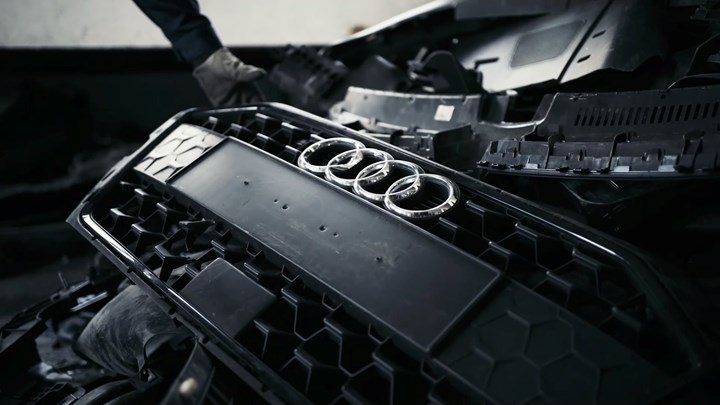
A first-time collaboration to help close the loop for mixed automotive plastic waste has been underway between polyolefins manufacturer LyondellBasell and Audi. For the 2023 Audi e-tron luxury SUV and its coupe-shaped Sportback sibling, Audi is installing plastic seatbelt buckle covers made using LyondellBasell plastic that supports the sourcing of feedstocks from mixed automotive plastic waste. Plastic components from customer vehicles that can no longer be repaired are dismantled, shredded, and processed by chemical recycling into pyrolysis oil.
The pyrolysis oil is then used as a raw material in LyondellBasell’s manufacturing process for the production of new plastics, replacing virgin fossil feedstocks. The recycled content is attributed to the Audi product via a mass balance approach. Said new business development director Erik Licht at LyondellBasell Advanced Polymer Solutions, “As part of the PlasticLoop project, we are working with Audi to establish an innovative closed-loop process, recycling plastic automotive parts for use in new vehicles. For the first time, we are using chemical recycling to recycle mixed automotive plastic waste into plastic granulate for automotive interior applications.”
With this process, LyondellBasell, Audi, and chemical recycler SynCycle (Next Generation Group and BDI), succeed in recycling a stream of material which today is mostly only suitable for energy recovery. This reduces the usage of fossil-based primary materials for the Audi Q8 e-tron and keeps valuable feedstocks in a circular loop. Materials produced from pyrolysis oil reportedly are of the same high quality as virgin materials and have the same properties. Chemical recycling offers an alternative to energy recovery and complements mechanical recycling.
Related Content
-
Braided thermoplastic composite H2 tanks with co-consolidated molded boss areas to fit EV battery space
BRYSON project demonstrates possible designs, automated manufacturing and low permeability concepts, including EVOH liner and novel PPA matrix.
-
Co-molding SMC with braided glass fiber demonstrates truck bed potential
Prepreg co-molding compound by IDI Composites International and A&P Technology enables new geometries and levels of strength and resiliency for automotive, mobility.
-
Advancing the Thermoplastic Composite Battery Enclosure into Production
Having achieved its first few commercial series successes, Kautex Textron explains the design process for its Pentatonic battery enclosure platform, which comprise glass fiber/PP or PA6 and injection overmolding a compression molded laminate.


