
This unique composite solution will make gas pipelines safer
Haydale Composite Solutions (HCS, Loughborough, UK) has developed a revolutionary composite “gas transition piece” for UK’s utility company National Grid. The composite piece fits around high pressure natural gas transmission pipes.


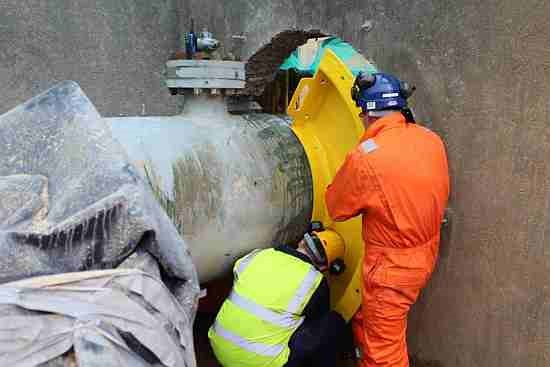
A Haydale Composite Solutions' gas transition piece (GTP) being installed.
Haydale Composite Solutions (HCS, Loughborough, UK) has developed a revolutionary composite “gas transition piece” for UK’s utility company National Grid. The composite piece fits around high pressure natural gas transmission pipes to prevent water ingress at “transitions” where pipes pass through concrete inspection pits. In the current situation, without such seals, says Paul Ogden, a senior civil engineer with National Grid, the company would be forced to excavate and remove concrete surrounding the pipe to get a good look at the pipe’s condition. Plus, that transition point where the steel pipeline enters the fresh air of the pit is a “focus point” for corrosion of the steel. National Grid understandably is concerned about the potential hazards of removing the concrete around the pipe perimeter and risking damage to the pipeline.
The HCS Gas Transition Piece (GTP) solution is a series of molded composite segments that fasten together around the pipe’s annulus (see photo), designed to allow technicians to quickly remove it, easily inspect the pipe for any corrosion issues or damage, and then put it all back in a relatively simple operation. While details about the molded composite itself are proprietary, HCS’s technical director Nick Weatherby told CW that the key to the GTP’s application is a unique elastomeric hydrophilic gasket-type seal that swells to approximately 400% in volume in the presence of water. “The GTP is installed with the seals dry so there is a lot of clearance and the segments can be easily positioned. Once in place and exposed to moisture/water the seals expand over a period of about 24 hours and seal the interface between the GTP and the pipe. The process is reversible in that during prolonged dry spells the seal dries out, then returns to its original size when wet,” says Weatherby. The seals are manufactured by extrusion and are fabricated to fit the GTP with a series of cutting templates and special adhesives and grouts that are also hydrophilic. Again, details on the seals and the additives that go into the elastomer are proprietary. With the seal, the GTP forms a water-tight seal around the pipeline to help lessen corrosion in the transition zone.
Working closely in conjunction with the National Grid’s R&D department, Haydale was recently awarded a contract extension to develop 14 different GTP solutions for seven different pipeline diameters, from 300-1050 mm. Each size has a variant for use on sites where access to the pipe is restricted by lack of access. This will enable the GTP solution to be rolled out across the entire gas transmission network in the UK. National Grid has identified the need for a total of approximately 300 units, and work on the contract is likely to span the next 15 months or so.
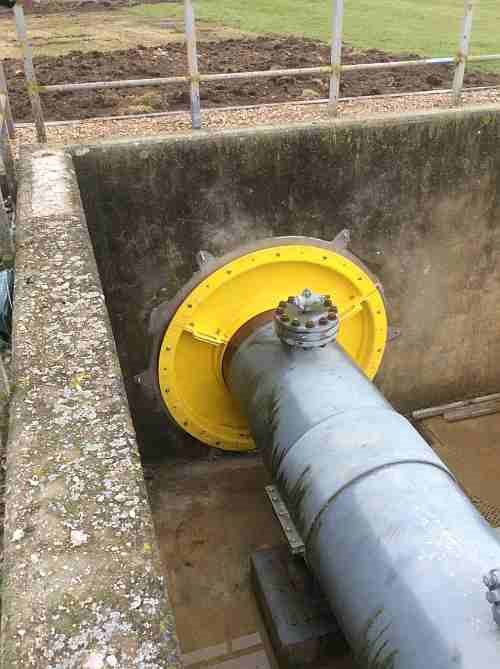
A completed GTP inside the inspection pit.
After installation, the composite GTPs can be readily removed, without the need for heavy lifting equipment, excavation work nor demolition to cut through the concrete walls. Engineers can carry out rapid inspections of the pipeline with considerable time and cost savings. Weatherby adds, “We have been working in infrastructure for 25 years and the GTP idea builds on that experience. The sealing system prevents ingress of water, sand or debris that might cause abrasion. To remove with the seals expanded, the GTP comes complete with a series of jacking pins that ease out the segments for inspection.” The bottom line: GTPs dramatically reduce the risk of damaging a large high-pressure transmission pipe and offer huge savings on time and cost for pipe inspection.
National Grid's Ogden says “During the next 6 years, up to 60 of these units are likely to be installed in the National Transmission System and will significantly improve safety as well as creating savings of up to £5 million in the next five to ten years, with further savings beyond that."
Watch this YouTube video by National Grid to see how the composite seals are installed: https://www.youtube.com/watch?v=GH96Kk-cBII. Contact Haydale Composite Solutions directly for more information: +44-1509-21007 / http://www.haydale.com/solutions/composite-solutions/


Related Content

U.S. grant is awarded for patented SIP composites formwork system
ConTech stay-in-place (SIP) technology, made from recycled composite materials, replaces the use of reinforcing steel in the construction of flat, elevated concrete surfaces.
Read More
Sustainable Infrastructure Systems creates fiber-reinforced post-consumer plastic structural panels
Australian composites manufacturer offers a scalable building solution, already established in a pedestrian bridge application, to tackle unprocessed soft plastics waste.
Read More
Renco USA brings Lego-style composite building system to construction
After more than a decade dedicated to R&D, evaluation and testing, the company has proven its MCFR building system in a Lakewood Village project in Florida.
Read More
Norco GFRP molds meet high-quality cast concrete beam production needs
A project with P&M successfully achieved manufacture of six 20-meter-long architectural beams for an R&D facility with near-seamless surfaces and on a tight production schedule.
Read MoreRead Next

Ultrasonic welding for in-space manufacturing of CFRTP
Agile Ultrasonics and NASA trial robotic-compatible carbon fiber-reinforced thermoplastic ultrasonic welding technology for space structures.
Read More
Scaling up, optimizing the flax fiber composite camper
Greenlander’s Sherpa RV cab, which is largely constructed from flax fiber/bio-epoxy sandwich panels, nears commercial production readiness and next-generation scale-up.
Read More
Cutting 100 pounds, certification time for the X-59 nose cone
Swift Engineering used HyperX software to remove 100 pounds from 38-foot graphite/epoxy cored nose cone for X-59 supersonic aircraft.
Read More