
Composites end markets: Sports and recreation (2024)
Light weight and high performance continue to make composites popular in the elite sporting good market. Sustainability in both materials and recycling solutions are a key innovation area.
.jpg;width=70;height=70;mode=crop;format=webp)



Folsom Custom Skis specializes in customized, hand-built skis for its customers. After a careful prototyping and testing process, the company worked with hybrid materials supplier Mito Material Solutions to redesign its carbon fiber composite touring skis with graphene enhancement to create a lighter weight, higher performance backcountry touring option. Photo Credit: Folsom Custom Skis
Composites, known for light weight and high performance, have been used in a variety of sporting goods applications for decades, including skis and snowboards, golf clubs, tennis rackets, watersports equipment, bicycle frames and more.
According to the most recent “Composites in Sporting Goods Market” report from market research firm Lucintel (Irving, Texas, U.S.) published in October 2023, the future of composites in the global sporting goods market “looks promising,” expected to reach an estimated $1.2 billion by 2028 with a CAGR of 5.9% from 2022 to 2028. Light weight and high performance are cited as major drivers for this growth.


Lucintel reports that golf shafts and clubs, skis and snowboards are the most significant applications of composites in sporting goods today. Emerging industry trends are reported to include the introduction of hybrid materials for superior performance, and a burgeoning interest in recycling.
What’s new in this market over the past year? Several announcements made in 2023 that CW covered include:
-
Graphene products from Mito Material Solutions (Indianapolis, Ind., U.S.) are improving mechanical properties and reducing overall material use for several sporting goods applications, such as Folsom Custom Skis’ ultra-lightweight carbon fiber composite touring skis and St. Croix Fly’s (Park Falls, Wis., U.S.) premium fly fishing rods.
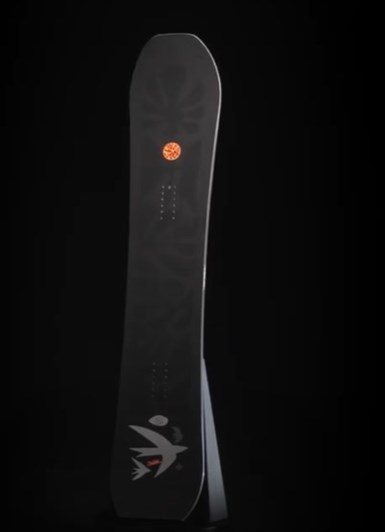
Salomon’s Highpath is made with a mix of materials, including glass and basalt fiber stringers along the length of the board to increase strength. Photo credit: Salomon
- Watersports equipment manufacturer HO Sports (Snoqualmie, Wash., U.S.) launched a new Sabre water ski featuring Checkerspot’s (Alameda, Calif., U.S.) bio-based foam core.
- Salomon (Annecy, France) launched its most sustainable snowboard yet, featuring bio-based epoxy, glass and basalt fiber, and recycled materials.
- Graphene product supplier Haydale (Ammanford, U.K.) announced that its graphene masterbatch is enabling lighter, stronger composite sea kayaks made by Norwegian manufacturer Norse Kayaks.
Strides are also being made in the areas of composites-intensive bicycles, protective equipment, overall sustainability and — beyond sporting goods altogether — recreational vehicles.
Growing market for composite bikes
Notably, carbon fiber-reinforced polymer (CFRP) bicycle frames are a material of choice for high-performance cycling. According to CW’s 2022 feature covering the current landscape for CFRP bike frame manufacture, a majority of composite bike frame fabrication occurs in Asia, producing up to 99% of CFRP bike frames globally. Most of these frames are produced via hand layup using carbon fiber-reinforced epoxy prepreg.
However, many companies in North America and Europe reported goals of becoming more competitive in the coming years with automated processes and thermoplastic materials adoption.
New composite bicycle announcements in 2023 included:
- The launch of Lotus’ (Norwich, U.K.) lightweight, electric Type 136 road bike featuring a carbon fiber composite frame;
- The development of the Lion high-performance children’s bike by KraussMaffei (Parsdorf, Germany) and its partners, featuring a frame and fork reinforced with recycled carbon fibers;
- An agreement signed between E-bike manufacturer Isoco Bikes (Saalfeld, Germany), plastic fabrication company V Frames (Schmiedefeld) and Lehvoss Group (Hamburg) to introduce high-performance fiber-reinforced compounds, including long carbon fiber and biopolymer carbon fiber composite materials, into bike frame and component production
- Colored carbon fiber composite wheels introduced by HypeTex (London, U.K.)
- An announcement from Time Bicycles (Gajary, Slovakia) of a new carbon fiber bicycle manufacturing factory to be built in Spartanburg, S.C., U.S., to feature optimized processes like high-pressure resin transfer molding (HP-RTM) in development with Time Bicycle and its partners.
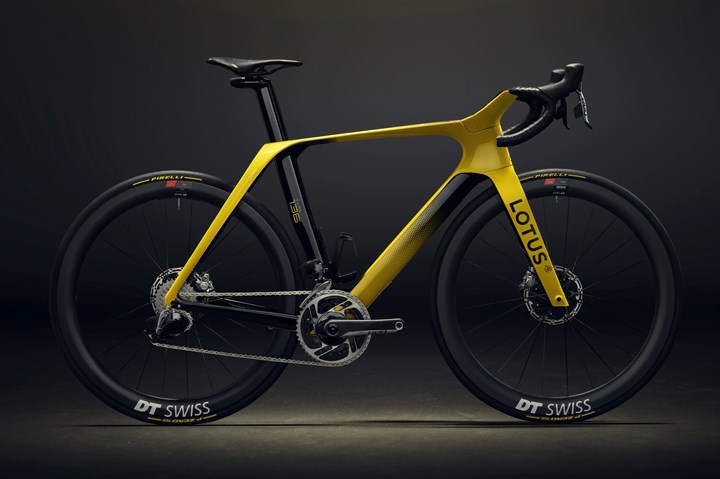
Handmade in Italy, the lightweight carbon fiber frame and state-of-the-art components mean Lotus’s Type 136 weighs just 9.8 kilograms. Photo Credit: Lotus
With a growing number of composite bicycles, comes the need for more and optimized carbon fiber bicycle frame repair. One new announcement this year was the start of a collaborative research effort between Cycle Inspect (Sydney, Australia) and the University of New South Wales (UNSW, Sydney) exploring the prevalence and impact of structural damage in carbon fiber bicycles.
Athletic shoes, protective equipment
In addition to sports equipment, premium athletic gear such as shoes can also incorporate composite materials. For example, carbon fiber composite plates for elite running and other athletic shoes remain popular with major brands. Over the past several years, Carbitex Inc. (Kennewick, Wash., U.S.) has developed a line of flexible carbon fiber/thermoplastic plates for use as soles in athletic shoes. These plates, designed to flex with the human foot but add strength and stiffness in needed areas, have been launched to the market as soccer cleats, work shoes and more, including a new line of Saucony trail shoes in fall 2022.
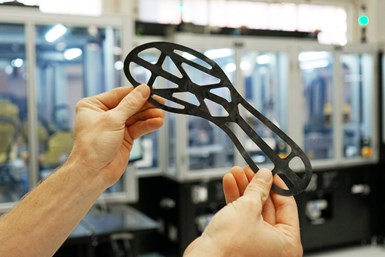
Nike popularized carbon fiber plates for running shoes, but rival Brooks wanted to optimize and lightweight the design. It turned to Arris and Additive Molding to design and manufacture this highly optimized plate for a new Brooks shoe expected to come to market in 2024. These plates are produced in a cycle time of 45-60 seconds. Photo Credit: Arris Composites
In 2023, a carbon fiber composite shoe plate made with Arris Composites’ (Berkeley, Calif., U.S.) Additive Molding process graced the cover of CW’s September issue. Manufactured for customer Brooks, the highly optimized plates are expected to come to market in 2024.
CompositesWorld also covered the launch of fiberglass/thermoplastic composite running shoe insoles from Flexi-StiX LLC (Anderson, S.C., U.S.), which aim to meet the desire for higher performance in a less-expensive, everyday running shoe.
In addition to shoes, composites are being used in efforts to produce stronger, more impact-resistant helmets for athletic activities. New developments include:
- A Black Diamond (Salt Lake City, Utah, U.S.) pinnacle climbing helmet made with Aluula Gold, a material from Aluula Composites (Victoria, B.C., Canada) that combines thin polymer films with ultra-high molecular weight polyethylene (UHMWPE) fibers
- Made-to-order, personalized carbon fiber-reinforced nylon bicycle helmets launched by Jabil Inc. (St. Petersburg, Fla., U.S.) with KAV Sports (Redwood City, Calif., U.S.).
Sustainable materials and recycling
Sustainability is a recurring theme across sectors and end markets, affecting raw materials production, materials supply, energy used in manufacturing, part design, new uses for manufacturing waste, end-of-life (EOL) solutions and more. The composite sporting goods market is no exception.
For example, as mentioned in several examples above, an increasing number of sporting goods companies have announced product offerings — either at the R&D/prototype level or commercialized — that feature bio-based materials such as bio-based epoxies or natural fibers to replace either fossil fuel-based carbon fibers or traditional resins.
Cobra International (Chonburi, Thailand), known in the watersports market since 1978, has launched multiple products to the market using more sustainable bio-based materials, such as its CocoMat coconut fiber technology and bio-based surfboards. In recent years the company has also reported efforts to improve its operations to be more sustainable, such as reduction in water and gasoline use.
In 2020, resins supplier Sicomin (Châteauneuf les Martigues, France) launched GreenPoxy, a line of bio-based epoxies and gelcoats featuring up to 51% certified bio-based carbon content. These materials are designed for use in various industry applications, but recently have been adopted by several watersports manufacturers. A few examples in 2022 include use of GreenPoxy products in Decathlon’s (Lilles, France) JIB and Block wakeboards, and Notox’s (Basque, France) R-Carbon surfboards, which also feature recycled carbon fiber from aerospace scrap.
Use of natural fibers like flax or hemp is growing across end markets, including sporting goods applications like an award-winning motorbike brake disc cover developed by KTM Technologies (Salzburg, Austria) that demonstrated, flax fiber fabrics from Bcomp (Fribourg, Switzerland) as one of its key materials.
Methods for collecting and recycling or repurposing composite sporting goods is also of growing interest. Challenges abound, however, starting with the logistics of collecting individual pieces of equipment from consumers at their EOL. One collaborative effort in this area is the Carbon Fibre Circular Alliance (CFCA), a group of sporting good bodies, equipment manufacturers, academics and composite specialists working on developing both partnerships and solutions for reclaiming and reusing the material from composite sporting goods equipment — and also potentially remaking new equipment from those materials.
Beyond sports: Recreational vehicles and more
Sporting goods are a high-profile and growing market for composites, but it’s worth nothing that composites are used in a variety of other consumer products and recreational equipment as well, from swimming pools and spas to outdoor furniture.
One heavy market area for fiberglass composites is recreational vehicles (RV), which often include composite wall panels, roofs and floors to save weight.
The RV Industry Association (RVIA, Reston, Va. and Elkhart, Ind., U.S.) reports that industry forecasts expect RV shipments to hit 350,000 in 2024, representing up to a 15.8% increase in expected year-end range for 2023, predicted at a median total of 307,700 units. In comparison, in 2021 the RVIA reported a record sales year thanks to the COVID-19 pandemic, hitting more than 600,000 units shipped. High interest rates, declining consumer buying power and built-up RV inventory are cited as reasons for 2023’s decline, but RV Industry president and CEO Craig Kirby says the latest forecasts indicate “a poised recovery with anticipated moderate increases in 2024 and a subsequent accelerated growth trend in the latter half of the year.”


.jpg;maxWidth=300;quality=90;format=webp)


Related Content

Composites end markets: Boatbuilding and marine (2024)
As the marine market corrects after the COVID-19 upswing, the emphasis is on decarbonization and sustainability, automation and new forms of mobility offering opportunity for composites.
Read More
Composites end markets: Industrial (2024)
The use of composites in industrial applications is increasing, driven by the need for higher performance and longer life, whether its parts for industrial machinery, EOAT components, corrosion-resistant equipment and more.
Read More
Materials & Processes: Resin matrices for composites
The matrix binds the fiber reinforcement, gives the composite component its shape and determines its surface quality. A composite matrix may be a polymer, ceramic, metal or carbon. Here’s a guide to selection.
Read More
Composites end markets: Automotive (2023)
Electrification and a focus on sustainability lead to opportunities and innovations in composites, from battery enclosures to structural components and more.
Read MoreRead Next

Fairmat, Decathlon partner for environmentally friendly composite sports equipment
Fairmat is deploying its low-impact virtuous production chain for the production of recycled carbon fiber, to be used to produce Decathlon’s Kuikma padel rackets starting in 2024.
Read More
Mansory program modifies Lamborghini Aventador sports car
In honor of the super sports car, the “one-of-one” converted Mansory Carbonado GTS combines visual aesthetics and technical functionality, complete with a full carbon fiber body and exterior composite components.
Read More
CRP USA 3D printing composites meet critical needs of bobsledding sport
Components critical to a bobsled’s functionality — push handles, hand grips and seats — were tailored from Windform materials, heightening both performance and safety for athletes’ racing in the 2026 Winter Olympics.
Read More