
New refrigerated semi trailer incorporates hybrid composite-metal technology
Wabash National Corp. (Lafayette, IN, US) unveiled its road-ready, customer-owned, refrigerated, all-composite van trailer with a composite-metal hybrid floor yesterday.

Share
Read Next


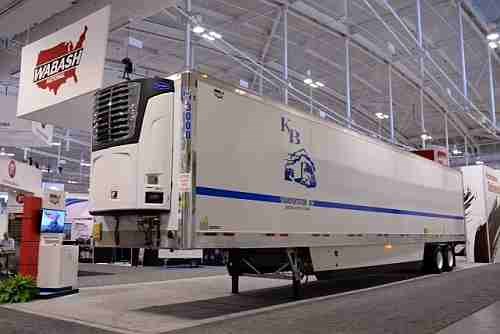
The Molded Structural Composite Cold Chain Series refrigerated van is all-composite, with a composite/metal hybrid floor offering exceptional strength.
Wabash National Corp. (Lafayette, IN, US) unveiled its road-ready, customer-owned refrigerated van trailer at yesterday’s 2017 Technology and Maintenance Council (TMC) annual meeting and Transportation Technology Exhibition in Nashville, TN, US, an event of the American Trucking Assns. (Arlington, VA, US). The new trailer, owned by K&B Transportation (Sioux City, IA, US), is the culmination of Wabash’s promise to have a finished trailer incorporating innovative composite design and materials at the 2017 show, after announcing the concept last year.
The Molded Structural Composite Cold Chain Series refrigerated van offers 25% better thermal efficiency than traditional reefers, yet is 20% lighter than existing traditional vans, says Wabash president and chief operating officer Brent Yeagy: “We see this product as an increased value proposition for our customers. We currently have four customers signed up, and we are ramping up production.” In addition to K&B, the customers include Werner Enterprises, Leonard’s Express and Combined Transport.


Yeagy and Robert Lane, vice president of product engineering at Wabash, along with Scott Lewit, president of Structural Composites (Melbourne, FL, US), who is a consultant on the project, talked with CW last evening just before the unveiling at the Nashville show. Lewit explains that the trailer is manufactured with all-composite sides and top, using the sandwich technology first described in this November 2015 blog posting at CW’s Web site, regarding Wabash’s adoption of composites: http://www.compositesworld.com/blog/post/camx-redux-more-green-more-customized-composites-even-in-space-and-more-growth. What makes the Molded Structural Composite Cold Chain van really unique is the innovative floor. Instead of a typical steel cross-member structure with an insulated floor attached to it, Lewit explains that the Cold Chain design is a co-molded and co-cured assembly of hollow aluminum extrusions (which allow cold air to flow through the floor) and composite structure laminated directly on the metal. Structural Composites’ patented (more patents pending) CoCure Strain Tunable Resin, a mixture of commodity polyester with varying percentages of polyurethane, has been formulated for compatibility with the metal; the hybrid metal/composite structure is laminated and cured as a 53-ft long single part. “This is a multifunctional blending of materials, which gives us the ability to best use the properties of the composite and the metal,” says Lewit. While the exact details of reinforcements weren’t disclosed, the three say carbon fiber can be used in the floor structure where needed, to meet customer specifications. A combination of glass with small amounts of carbon fiber helps keep cost down, and adds Lewit, “The metal provides some extra modulus.”
The innovative co-molded floor structure is about 11 centimeters thick (4.5 inches), compared to a conventional refrigerated van’s 22-centimeter floor. More importantly, the new design provides a 50% increase in floor rating, that is, how much fork lift load it can support. A standard reefer van floor is rated at 16,000 lbs, and current “dry” vans (those carrying dry goods, not refrigerated) are rated at 20,000 lbs. Says Yeagy, “This new floor has a 24,000 lb rating. There is no other 24k fork lift rated reefer van out there today. This is a real breakthrough.” Lane adds, “You’re getting a 50% increase in floor rating, with a much thinner structure.”
The bottom line: with the hybrid floor, the Molded Structural Composite Cold Chain Series refrigerated van can be used for both refrigerated and dry loads, which improves profits for shippers with more “backhaul” opportunities (i.e., the ability to carry goods on a return trip). Yeagy explains that 100+ trailers will be produced over the next 18 months, with much of the production occurring at the company’s recently-acquired composites manufacturing facility in Little Falls, MN, US, a former Larson Boat plant (see CW’s story on that acquisition: http://www.compositesworld.com/news/wabash-national-to-open-composites-manufacturing-facility-in-minnesota). Concludes Yeagy, “We’re very optimistic about the new trailer, and we think we have generated a lot of buzz in the industry.” Adds Lewit, “Wabash has the commitment to push through new technology and disrupt the industry — there are a lot of breakthroughs here.”


Related Content

Hexagon Digital Wave provides requalification services for oilfield service company’s gas transportation fleet
Noninvasive modal acoustic emission (MAE) technology will support composite cylinder inspection for the U.S. company’s virtual pipeline trailers through 2027.
Read More
Award-winning Oder river bridge cuts 500 tons of steel with CFRP tension cables
Developed by Carbo-Link and tested by Empa, the Oder Bridge near Küstrin is a heavy rail bridge using 88 CFRP tension members, enabling 120 km/hr train speeds with reduced weight and emissions.
Read More
Composite Braiding awarded for TPC twin track cantilever support
Railway infrastructure cuts weight by 84%, carbon emissions by 80% and installation time by 50% while automated process offers ≥90% lower labor costs, waste and energy use versus traditional composites manufacturing.
Read More
National Composites Week 2025: Transportation
Commemorating the theme “Performance With Purpose,” CW has gathered key stories over the last year that exemplify how composites have progressed commercial automotive and mass transit.
Read MoreRead Next

Polestar 5 takes aesthetics and circularity approach to biocomposite seatback design
The 2026 Polestar 5 expands the company’s use of sustainable materials design in the interior, including flax fiber/thermoplastic seatbacks that save 7 kilograms of weight and reduce overall plastics use.
Read More
Post Cure: CFRP mainframe, modern manufacturing techniques pioneer next-generation rigid airships
Advanced composites enable the revival of rigid airships in LTA Research's 400-foot-long Pathfinder 1.
Read More
Sentherm conductive polymers match aluminum thermal performance, cut weight
Tailored filler networks, anisotropic material design and manufacturing process control achieve hybrid polymers for EVs, batteries and other automotive-related electronics with 95% of aluminum’s thermal performance and 25-45% reduced component weight.
Read More