
The making of the BMW i3
CompositesWorld's tour of the BMW i3 manufacturing and assembly plant in Leipzig, Germany, offers a glimpse of one possible future of automotive production.


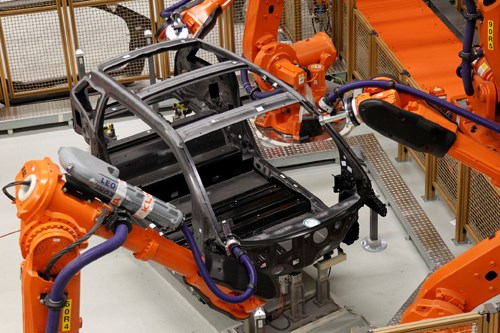
The Life Module of the BMW i3 all-electric is comprised of resin transfer molded carbon fiber composite structures that are assembled via robotics at the company's manufacturing and assembly plant in Leipzig, Germany.
The composites industry is full of innovators and creative thinkers, people who move the industry forward incrementally toward greater efficiencies, lower costs and higher quality. But the big material and process leaps the composites community has seen throughout its history have required more than individual expertise. The Chevrolet Corvette or The Boeing Co.’s 787 Dreamliner, for example, is the product of a massive, collective corporate commitment, backed by a capital investment as big, bold and precedent-setting as the envisioned product — a commitment that, to some composites pessimists, appears reckless, hasty, ill-timed and doomed.
Corporate trailblazers are rare, and rarely attempt such leaps without a good command of the materials, processes and technologies required to achieve success. Even so, the risk of doom is real, and redoubles with the size of the enterprise. Missed deadlines and technical setbacks are all the more embarrassing for being so public — and inevitably exploited by naysayers. But at the end of what is, at best, a colossal controlled experiment is the honor and recognition as the first to reach a bold and audacious goal.


Onto this less-traveled corporate road the BMW Group steered when, in 2009, it elected to manufacture an all-electric, four-door passenger car using carbon fiber composites. Originally denoted the MegaCity Vehicle, the commuter car now known as the i3 is designed primarily for urban driving and can travel about 100 miles/160 km on a single charge.
As is widely known by now, the i3 features two primary structures, the aluminum Drive Module – which incorporates the powertrain, chassis, battery, and structural and crash functions – and the Life Module (passenger cell), made from carbon fiber composites. The latter is capped by a composite roof made with recycled carbon fiber, and features a spare but comfortable interior that also incorporates recycled materials and other composites made with natural fiber reinforcements.
We were invited in March to visit the i3 manufacturing and assembly plant in Leipzig, Germany and was offered a chance to see, firsthand, the materials and technologies employed in the creation of this unique vehicle. You will find, in the June issue of Composites Technology magazine, a full report on the facility, materials and processes.
In the meantime, some highlights and impressions from the tour:
- BMW, as might be expected, exerts strict control over the quality of carbon fiber produced and woven for the i3, starting at the SGL Automotive Carbon Fibers plant in Moses Lake, Wash., USA.
- Process control of the resin transfer molding (RTM) process used to make the carbon fiber structures for the Life Module is carefully managed. BMW uses, in Leipzig, seven Schuler presses for RTM, with two KraussMaffei RTM injection units on each press.
- BMW clearly is looking for opportunities to speed up its RTM process, reduce carbon fiber scrap rates and minimize resin usage. Thermoplastics are on the radar.
- The roof of the i3 makes creative use of carbon fiber scrap with the applicaiton of a stitched, nonwoven carbon fiber fabric made by SGL Group.
- Assembly of the Life Module — fully automated by 173 fully articulating ABB robots — is impressive. Only adhesive bonding is used, with no mechanical fasteners.
- BMW, when we visited, was making 70 i3 vehicles per day, which BMW says is on par with expectations — and expected to grow. With the i8 sports car (also with a carbon fiber Life Module) about to start production, the company's RTM throughput will be well tested.
- Driving the i3 is fun (see below image). It's smooth, peppy, quiet and responsive.

CompositesWorld conferences director Scott Stephenson (left) with editor Jeff Sloan (right) in front of the BMW i3 they drove while visiting the BMW Group manufacturing and assembly plant in Leipzig, Germany.


Related Content

Ross coaxial mixer enhances complex material processing
Ross Mixers introduces a custom coaxial mixer designed for blending, dispersing and homogenizing across industries like adhesives, coatings and composites.
Read More
Bonded fastening meets the digital factory
Automation and XR tools aim to scale adhesive fastening for composites at next-gen aerospace production rates.
Read More
Belzona composite wrap restores corroded carbon steel pipeline
Two-part epoxy paste, epoxy structural adhesive, composite wrap and anti-corrosion coating prevent environmental and economic loss for customer.
Read More
IPS Adhesives debuts Scigrip SG2000 adhesive in North America
The adhesive’s 1:1 mix ratio and long open time provides transportation, construction and marine industries with much-needed routine simplification and flexibility.
Read MoreRead Next

Report: Composites and Carbon Fiber Use in Hydrogen Storage
A first-of-its-kind technical report that assesses the materials, manufacturing processes, market and energy trends driving use of carbon fiber composites in global hydrogen (H₂) storage applications for fuel cell-powered trucks, buses, trains and passenger vehicles.
Read More
Industrial ultrasonic NDT adaptation permits accessible composite bicycle inspection
Cycle Inspect's ASNT-aligned certification program employs affordable twin-crystal ultrasonic testing equipment and standardized inspection methods to detect damage in composite bicycle components.
Read More
Advancing bonding, coating and sealing to 4.0 systems for composites, metals and more
Brighton Science uses decades of experience, 2-second surface measurements and a framework of data-based specs and KPIs to help manufacturers advance toward reliable, predictable bond quality for faster, high-performance production.
Read More


