
JEC Europe 2013: And on the second day, the snow melted
A relatively rare European snowstorm brought much of the continent to a halt on the first day of the JEC Europe 2013 show. But the show went on . . .


The JEC Europe 2013 trade show, being held this week in Paris, got off to an auspicious beginning with a rare and dramatic snow storm on Day 1 that shut down much of Europe and kept some exhibitors and many attendees either at home, stuck in an airport or stranded at a train depot. All the same, enough composites professionals slogged through the ice and snow to make the first day successful, and sun on the second day banished much of the moisture. CW editors were among the attendees and offer some highlights.


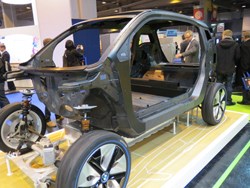
In the Innovation Awards corner of the hall, the big attraction has been the award-winning carbon fiber passenger cell of the forthcoming all-electric BMW i3 car (see photo). Featuring SGL Group (Wiesbaden, Germany) carbon fiber produced in the U.S., and due on the market later this year, the i3 represents the first production vehicle to use carbon fiber in the passenger cell and deserved the attention it received. The question looming over the i3 has been what the body panels would be manufactured of. Official word is scarce, but injeciton molding machine maker ENGEL reports that it has sold two large machines to BMW for use in its Leipzig, Germany, facility "to manufacture lightweight components for car body shells." The car is not identified, but if one reads the tea leaves, and understands that the Leipzig plant is being used for primary asembly of the i3, then it's probably not unfair to assume that the i3 body panels will indeed be plastic.
Carbon fiber manufacturer Hexcel (Stamford, Conn., USA) held a press conference on Day 1 and reviewed the role its materials are playing on the Airbus A350 XWB, which is more than 50 percent composites by weight and expected to fly for the first this summer. Hexcel's HexPlay, HexTow and Acouti-Cap products are used variously in the A350's fuselage cockpit, fuselage, vertical tail and horizontal stabilizer, wing covers and spars, wing leading and trailing edges, center wing box, belling fairing and other parts. All told, said Hexcel officials, each A350 XWB represents $4 million in revenue from composite materials. Equally, if not more, interesting was Hexcel's introduction of HiTape UD, a dry carbon fiber for automatic placement applications and out-of-autoclave vacuum infusion processing. Hexcel says it's targing the material to aerostructures applications and exhibited on its stand a demonstration panel molded by Spirit AeroSystems (Wichita, Kan., USA) using the new HiTape UD product (see photo).
Radius Engineering (Salt Lake City, Utah, USA) got some attention on its stand for the 7m/23-ft carbon fiber multispar flap molded in one shot using the same qualified resin transfer molding (SQRTM) process, which provides autoclave-like consolidation outside of the autoclave. The flap, which Radius says is designed (but not necessarily destined for) an Airbus A320, is made with Cytec 977-2 prepreg and molded in a compression molding machine built by Radius. The tool features aluminum mandrels in the core. Additional pressure, per the SQRTM process, is provided also by resin injected around but not into the fabric by a Radius injection system.
JEC Europe wraps up on Thursday, March 14.


Related Content

Assembling the Multifunctional Fuselage Demonstrator: The final welds
Building the all-thermoplastic composite fuselage demonstrator comes to an end with continuous ultrasonic welding of the RH longitudinal fuselage joint and resistance welding for coupling of the fuselage frames across the upper and lower halves.
Read More
Advancing mold release technology for aerospace composites manufacturing
Chem-Trend’s water-based, silicone-free mold release agent eliminates release curing time and provides easy tool cleanup.
Read More
Otto Aviation launches Phantom 3500 business jet with all-composite airframe from Leonardo
Promising 60% less fuel burn and 90% less emissions using SAF, the super-laminar flow design with windowless fuselage will be built using RTM in Florida facility with certification slated for 2030.
Read More
Plant tour: Collins Aerospace, Riverside, Calif., U.S. and Almere, Netherlands
Composite Tier 1’s long history, acquisition of stamped parts pioneer Dutch Thermoplastic Components, advances roadmap for growth in thermoplastic composite parts.
Read MoreRead Next

Dialing in composites performance via dynamic digital twins
Sport Dynamics Lab uses Flexdynamics testing, digital models and AI tools to compare designs, materials and systems, enabling optimization with potential for propellers, drones and vibrational structures.
Read More
Advancing bonding, coating and sealing to 4.0 systems for composites, metals and more
Brighton Science uses decades of experience, 2-second surface measurements and a framework of data-based specs and KPIs to help manufacturers advance toward reliable, predictable bond quality for faster, high-performance production.
Read More
Post Cure: 3D printed plastic, composite mouthstick designs assist limited-mobility users
Three M Tool and Machine has used its in-house additive manufacturing capabilities to rethink medical devices like mouthsticks, which must be stiff, lightweight and comfortable enough for everyday use.
Read More