
Mechanized arm speeds sanding while reducing injuries
EMMA being used by Boeing, Airbus and now a large wind blade manufacturer.


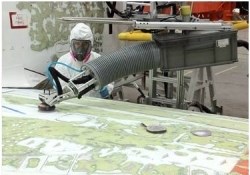
The number of large composite surfaces requiring sanding before bonding or painting is increasing rapidly as the Boeing 787, Airbus A350 XWB and next-generation single-aisle jetliners enter service.


The Easily Manipulated Mechanical Arm, or EMMA, is a pneumatic, mechanical arm developed by Temple Allen Industries (Rockville, Md.) during the 787 program to enable surface preparation of large composite wing and fuselage areas, where chemical solvent and stripper use is not allowed. EMMA is written into the 787 specifications as the only acceptable alternative to manual sanding and is approved for use on most commercial aircraft.
EMMA is a mechanized tool and not a robot to replace the worker. Instead, it improves worker productivity and eliminates the pain and injuries that surface preparation/finish personnel too often must endure. Vibration white finger (VWF, more typically known as hand-arm vibration syndrome or HAVS) occurs when capillaries in the fingers close down after hours of holding a sander or grinder. HAVS affects tens of thousands of workers and can damage blood vessels, nerves, muscles, and joints in the hand, wrist and arm. Its effects are cumulative, and become permanent with continued exposure.
In Europe, Occupational Safety and Health Administration (OSHA)-equivalent agency regulations limit vibration exposure. For example, U.K. workers cannot hold a sander past defined exposure limits, which are often less than half a shift. Though no such regulations exist in the U.S., most high-tech manufacturers are interested in reducing worker injuries and increasing sanding and machining quality and productivity.
Many people think that sanding composite surfaces is fairly simple, holding a tool while bending over a part on a table. But increasingly, the surface to be sanded is a fuselage or nacelle in front of the worker or the underside of a wing overhead. Combine that awkward position with the weight of the tool and the force required to make sure the surface is abraded adequately but not excessively, as well as the extended time periods required, and it is easy to see the potential for injuries, need for frequent breaks that slow productivity and factors that could produce inconsistency.
EMMA bears the weight of the tool, absorbs vibration, and holds the tool flat on the workpiece surface while applying a consistent contact force. The worker can sit or stand comfortably using a joystick to control direction and movement.
EMMA is used by Boeing (Renton, Wash.), Airbus (Broughton, U.K.), Northrop Grumman (Palmdale, Calif., USA), Embraer (São José dos Campos, Brazil), British Airways (Heathrow), Triumph Aerostructures - Vought Aircraft Division (Milledgeville, Ga., USA), and the US Air Force and Navy, among others. A unit is being installed now at a large wind blade manufacturing facility.
Thanks to a variety of deployment options (e.g. rail-mounted, telescoping stand, or belly system for sanding the underside of aircraft) EMMA can be integrated into various processes and operational set-ups. Watch EMMA in operation: http://www.templeallen.com/Videos.html
Related Content
-
Ross coaxial mixer enhances complex material processing
Ross Mixers introduces a custom coaxial mixer designed for blending, dispersing and homogenizing across industries like adhesives, coatings and composites.
-
Advancing bonding, coating and sealing to 4.0 systems for composites, metals and more
Brighton Science uses decades of experience, 2-second surface measurements and a framework of data-based specs and KPIs to help manufacturers advance toward reliable, predictable bond quality for faster, high-performance production.
-
Belzona composite wrap restores corroded carbon steel pipeline
Two-part epoxy paste, epoxy structural adhesive, composite wrap and anti-corrosion coating prevent environmental and economic loss for customer.


